Anaesthetics, Antenatal education, Anxiety, Being busy as a midwife, Birth, Change management, Communication, Compassion, Fear of Birth, Giving information, Helping others, Hospital, Human kindness, Kindness, Labour , birth, Labour and birth, MatExp, Midwife, Midwifery, Midwifery and birth, Newborn, NHS, NHS Systems and processes, Obstetrics, Paediatrics, Psychology, PTSD, Respect, Women's health, Women's rights, Young mothers, Young women

Loss of control – a reason for fear of birth ? 

When any of us are admitted to hospital we lose control . We are unable to get a hot drink when we want one , eat what we want when we want to ,take simple pain relief , go to the toilet , sleep as well as we would at home , get up in the night or stay in bed longer . We are also unable to control what we hear , what we see . We lose our safe place of home and being surrounded by friends and family – it feels lonely and alien to us . This doesn’t mean that we are not able to adapt to new situations it’s just that more than a few things change and this throws a curveball towards us .  The fear we feel is because we feel we are handing ourselves and our bodies , our routines and home comforts over to others, they are dismissed  – this has quite a destabilising effect on our psyche . 

A key part of NICE CG190 guidelines for care in labour encourages midwives to set the scene for women. The section I am going to focus on is COMMUNICATION – which is part of 1.2 Care throughout labour (click on the following numbers to be taken to the site)  CG190 

I have copied and pasted the exact words and written the key words in CAPITALS below to help highlight their impact – does it make you think about them differently ? 

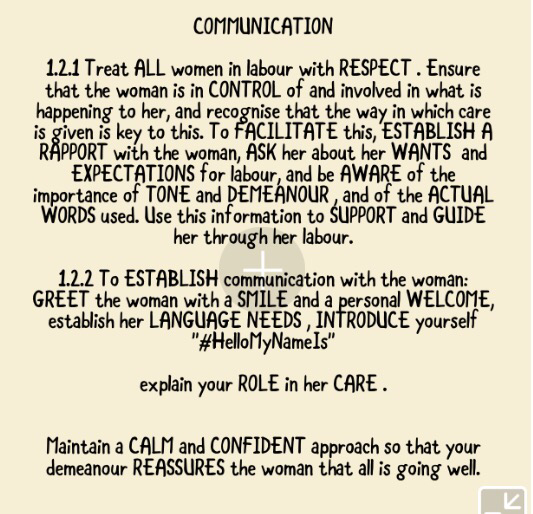
COMMUNICATION 

1.2.1 Treat ALL women in labour with RESPECT . Ensure that the woman is in CONTROL of and involved in what is happening to her, and recognise that the way in which care is given is key to this. To FACILITATE this, ESTABLISH a RAPPORT with the woman, ASK her about her WANTS  and EXPECTATIONS for labour, and be AWARE of the importance of TONE and DEMEANOUR , and of the ACTUAL WORDS used. Use this information to SUPPORT and GUIDE her through her labour.

1.2.2 To ESTABLISH communication with the woman:

GREET
the woman with a SMILE and a personal WELCOME, establish her LANGUAGE NEEDS , INTRODUCE yourself   “#HelloMyNameIs”

explain your ROLE in her CARE .
Maintain a CALM and CONFIDENT approach so that your demeanour REASSURES the woman that all is going well.

KNOCK
and WAIT before entering the WOMAN’S ROOM , respecting it as her PERSONAL SPACE , and ask others to do the same.

ASK
how the woman is FEELING and whether there is anything in particular she is WORRIED about.
If the woman has a written BIRTH PLAN , READ  and DISCUSS it with her.

ASSESS
the woman’s KNOWLEDGE of strategies for coping with pain –PROVIDE  BALANCED INFORMATION to find out which available approaches are ACCEPTABLE to her.

ENCOURAGE the woman to ADAPT to the environment to meet her INDIVIDUAL needs.
Ask her PERMISSION before all PROCEDURES and OBSERVATIONS, FOCUSING  on the WOMAN  rather than the TECHNOLOGY or the DOCUMENTATION .

SHOW the woman and her birth companion(s) how to summon HELP and REASSURE her that she may do so WHENEVER  and as OFTEN  as SHE NEEDS to. When LEAVING  the ROOM, LET her know when you WILL return.

INVOLVE
the woman in any HANDOVER OF CARE  to another professional, EITHER when ADDITIONAL EXPERTISE has been brought in or at THE END OF THE SHIFT. 

Every person who cares for (no matter how short a time ) a woman in labour should follow this guidance and I feel there should be posters up on maternity units in all languages which emphasise that this will happen . 

There are many barriers to communication and one that most midwives, student midwives , maternity health care assistants , obstetricians and anaesthetists agree on is that time, pressure and NHS systems restricts our practice. I want to have laminated cards that go with the analgesia cards to explain why kindness and compassion will also help ease women’s pain . Fear is a huge factor in the perception of pain and if we try to reduce fear we might help reduce not only  pain but also anxiety and then by this we will gain trust and build on positive care. 

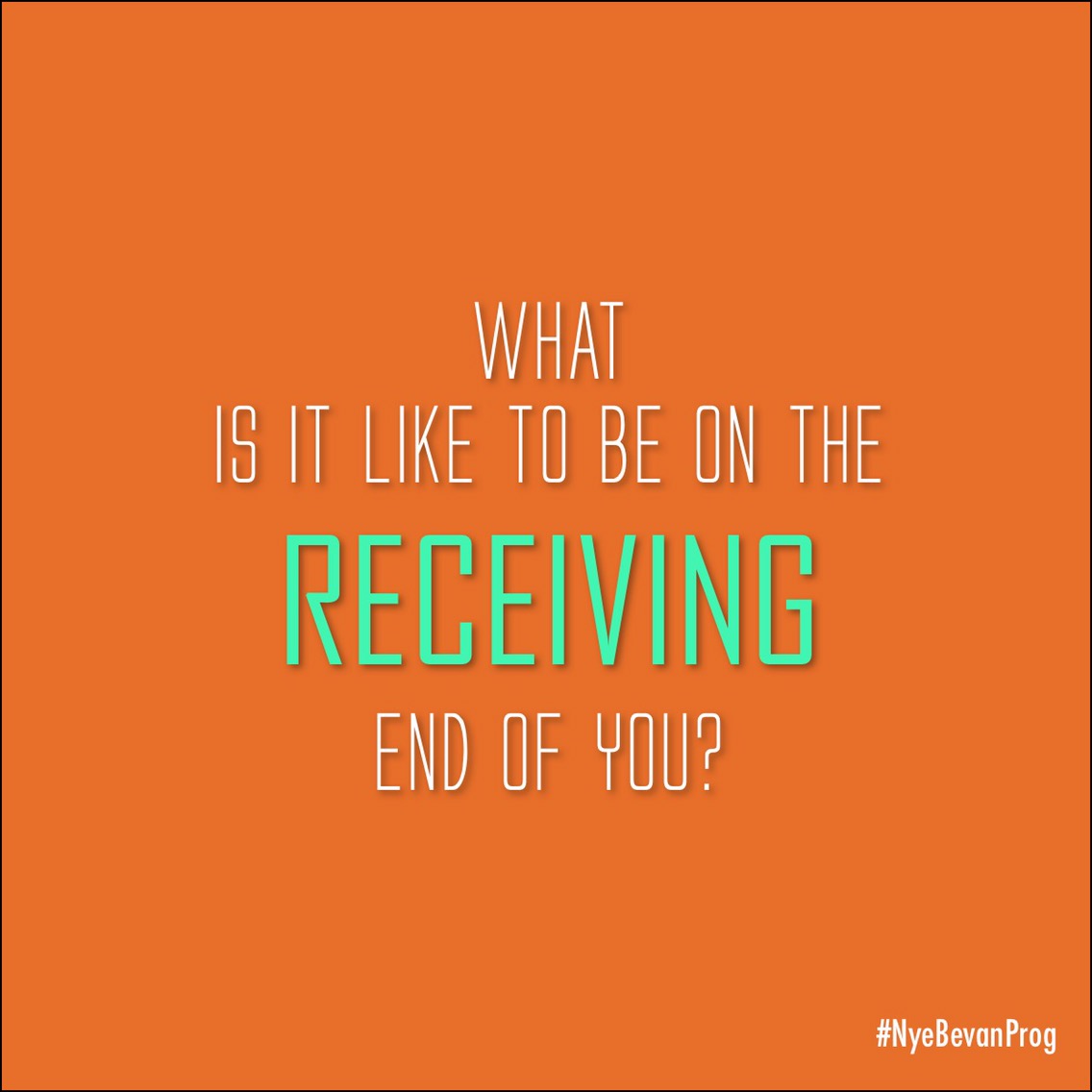
As the  midwifery workforce we must start to say to ourselves “how would I feel ? ” another question which is used on the Nye Bevan leadership module is this …. 

Lets keep sharing our ideas and thoughts and if you have any more relating to CG190 – tweet using #CG190 or why not write a blog or design a poster ? 
Thank you for reading and please leave comments , I always value them and they help me to reflect and grow . 


Yours in midwifery love 

Jenny ❤️

Against the odds, Anaesthetics, Antenatal education, Babies, Birth, Breastfeeding, Caesarean section, Change management, Children, Compassion, Courage, Giving information, Helping others, Hospital, Human kindness, Human rights, Intra-operative care, Kindness, Labour , birth, Labour and birth, MatExp, Midwife, Midwifery, Midwifery and birth, Motherhood, New parents, Newborn, Newborn attachment, NHS, NHS Systems and processes, Obstetrics, Paediatrics, Patient care, Postnatal care, Respect, Skin to skin contact, Student Midwives, Teaching, Women's health, Women's rights, Working from the heart

The Caesarean experience 

How good is the approach to women who have a caesarean to birth their babies ? Do all NHS trusts routinely give the same care to each woman and newborn or is it tailored to each individual ? 

I am passionate that the caesarean procedure is also a positive uplifting experience for the woman her partner and their newborn . 

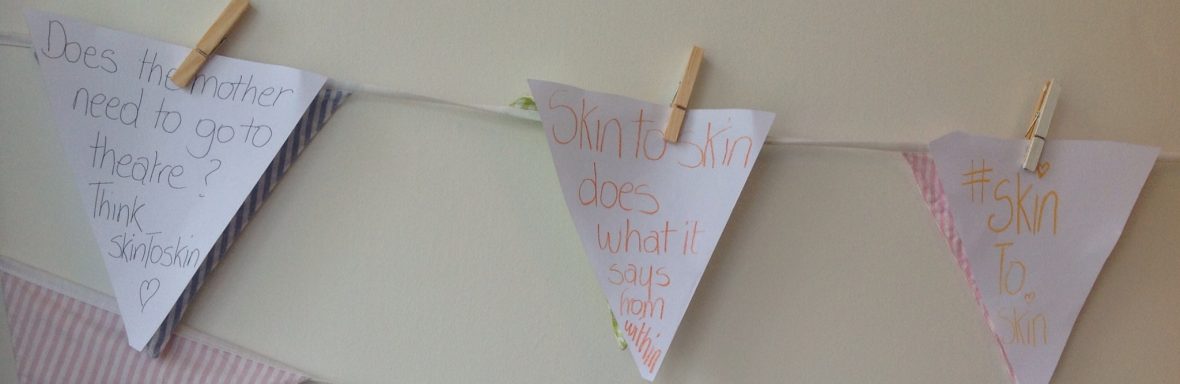
I get upset when I hear stories from different midwives at various NHS Trusts that skin to skin contact at Caesarean section isn’t routine or perhaps not discussed antenatally . From today I’m championing that skin to skin contact should be a priority for ALL WOMEN AND BABIES in the operating theatre and I’m doing this for several groups of women including those who

1. Were totally unaware that  skin to skin contact at caesarean was possible . 

2. Hear stories of women who held their baby skin to skin perioperatively when own their babies are older and they missed out on it which leaves them feeling robbed and upset. 

3. See photographs of babies in skin to skin contact during caesarean and they didn’t know they could take photographs 

4. Realised that skin to skin is possible but they weren’t given the choice 

5. Feel sad that the baby’s other parent wasn’t encouraged to hold their baby skin to skin during the caesarean operation . 

And this blog post is also for any woman who has an assisted birth in an operating theatre – I’m going to help you challenge NHS systems and change the birth discrimination between normal birth and birth in theatre . 

Why am I calling this BIRTH DISCRIMINATION

In my opinion every woman who gives birth should have the chance to hold her newborn in skin to skin contact even if only for a few minutes perhaps because the newborn requires transfer to neonatal unit or the woman feels unwell peri-operatively . 

Women who have a normal vaginal birth are more likely to hold their newborn for longer and separation from their newborns during the ‘golden skin to skin  hour’ will be less likely to happen. However, if a child is born in the operating theatre separation will occur within half an hour because of risk assessments meaning that the baby is moved as well as that within some NHS Trusts phones or cameras are not allowed in theatre and here are my thoughts on this matter which is close to my heart . 
We can no longer ignore the birth discrimination that exists between normal birth – where the woman has prolonged uninterrupted skin to skin contact – and assisted birth . It’s the role of everyone who is involved with birth in the operating theatre to work together to reduce and / or eliminate this birth discrimination.  I’m talking about midwives , anaesthetists , paediatricians , obstetricians , neonatal nurses , ODPs , maternity support workers coming together to form multi-disciplinary teams to plan how skin to skin contact length and opportunity can me maximised and separation minimised . 

We are all aware that skin to skin contact is beneficial in numerous evidence based ways (just go onto google scholar and search “skin to skin contact at birth”  to both mother and baby. It is NOW time to take action and assess each woman and baby individually instead of adhering to a ‘one size fits all’ approach . Of course there are women who may have to have a general anaesthetic – so consider this from the baby’s point of view – and work out a way that the other parent might be able to provide skin to skin for the newborn . 

We are in 2017 and now is the time to make change happen – talk about this to your MSLCs , the labour ward forum meetings , MDT meetings and be pro-active – together we can all make a difference 

Thank you for reading – jenny ❤️

To be continued ….. 

Babies, Birth, Breastfeeding, Caesarean section, Children, Compassion, Giving information, Helping others, Hospital, Human kindness, Kindness, Labour and birth, Learning, MatExp, Midwifery, Motherhood, New parents, Newborn, Newborn attachment, NHS, Obstetrics, Patient care, Skin to skin contact, Women's health, Women's rights, Young mothers, Young women

The baby’s here – NOW what ? 

You have just given birth – it’s your first child and I’m not sure whether you had a Caesarean birth or a forceps birth or your newborn arrived in a birth pool . What really matters is that you receive consistent, evidence based advice from the health care professionals you come into contact with and positive support from your family and friends –  you’ll be exhausted and must try not to rush yourself back to normality too soon – try installing a mindfulness app into your phone and ALLOW your friends to do your shopping/ ironing / take some laundry off your hands . Don’t be too proud to admit tiredness , worry and emotions .

Take a good look at the #MatExp website and join the Facebook page for access to health care professionals , peer supporters and other new parents – ask questions and interact with others so you can gain knowledge and know when to recognise that things might not be quite right .

The biggest thing to hit you right between the eyes is the responsibility of parenthood including how to cope with reduced amounts of sleep , hormone imbalances , post birth bleeding , the increase in laundry (which seems so huge for such a tiny person and more than double with twins !) and how to deal with unexpected visitors who always seem to turn up when it’s nap time . Who said babies sleep all day ?

Well here is my blog to try and help you to make some sense of your early days

Humans have been parenting for thousands of years , babies communicate through crying and facial expressions and you have an inbuilt mechanism that is made to help you to nurture your young . Keep on keeping on with skin to skin contact as new evidence shows that mothers who give their babies plenty of skin to skin contact are more responsive parents . Picking up your baby each time he or she cries is not spoiling the child – HERE IS A LINK TO EXPLAIN WHY A BABY DEVELOPS BETTER WHEN HE SHE IS PICKED UP MORE. UNICEF have lots of evidence based resources and this is a wonderful PDF document UNICEF leaflet on building a happier baby – we are in fact building humans – kindness and compassion towards our young helps the brain take in more information and this in turn reinforces to the child that kindness matters , so he she grows up to be more aware of her / his own feelings and the feelings of others .

Trying to sift thought all the postnatal advice leaflets and decide which friend / in-law , relative has the best advice on getting your baby to sleep is just overwhelming .

First of all don’t push yourself too much to get through one week unscathed – it’s better and more realistic to try and get through a couple of hours feeling positive about what you’ve achieved. Take regular pain relief to help your mobility and well-being and don’t scrimp on rest – did you know that skin to skin contact reduces pain in mother AND newborn?

Let’s move onto  the key things your baby needs to grow and develop as well as feeling nurtured
1.Love which includes feeling nurtured and receiving kindness . Love also means giving yourself kindness and listening to your own mind and body .A baby knows from the tone of your voice whether you are happy and feeling loving towards it – so try hard to keep love in your heart . If you are not feeling this way seek some advice – your love might come later , or you may just be exhausted . If you feel unwell , emotionally drained , or just flat talk to your midwife and let her know – she’s not their to judge you but to signpost you to the correct services available . Do not berate yourself if you are suffering from post-natal depression and/or anxiety – we live in a modern world that doesn’t seem to support the value of resting , being still and calmness – digital advances seem to put more and more pressure on us humans to try and prove we are beyond human – the modern woman  is the equivalent of a plate spinner – don’t take on too many committtments – try practising some self-care and slow down – your body and mind  need rest and stillness as much as they need love , nourishment , kindness and compassion . Here is a wonderful blog about a mother who realised she was shouting too much and was too distracted by others things that led to a kind of moodiness towards her children CLICK HERE TO READ

2. Feeding your newborn is not just about giving a baby milk – the way a baby is held during a feed , the way a mother talks to her newborn and keeping the number of people who give the feed to a minimum has a more positive impact on the baby’s developing brain. I hear many women say “I’m not going to breastfeed as my family want to help me with bottle feeding”.

The first feed of colostrum is a crucial power food to help the newborn to  begin its journey of life. Obesity is a now a public health problem and it’s time to address the low numbers of babies that are breastfed – if a baby maintains skin to skin contact with its mother at birth for over two hours – there is an increase in breastfeeding success – we are talking about not moving baby at all for any reasons including during Caesarean section, perineal sutures, returning to theatre for any reason and always considering SkinToSkin contact.

The postnatal period should include regular prolonged episodes of skin to skin contact to soothe babies , maintain the all important bond with the parents and help milk production . Breastfeeding helps babies to …

1.Recover from birth

2. Feel safe and nurtured

3.protect the immature gut and bowel by receiving immunity from the mother via her bespoke breast milk .

4.feel comforted – because a baby that breastfeeds must be held close and that situation is very comforting to a newborn

The one to “oneness” that #SkinToSkin and breastfeeding gives a newborn is actually is not something that can be replicated in another form – it’s a one off that’s been passed down the centuries , a primitive response that goes back in time to when we lived in caves and our mothers held us close away from other predators . It’s much more grounding for a newborn to feel close to less people and as it gets older you can widen the circle very gradually. SkinToSkin during breastfeeding gives the baby a strong sense of belonging . There are also responsive bottle feeding methods . The SLING LIBRARY offers information about slings across the U.K. click HERE for the website and slings give freedom to do other things whilst carrying your newborn hands free : )

A baby should never be fed without being held – being held during a feed is soothing and promotes a sense of safety & emotional security . Talking , singing and smiling during feeds with intense eye to eye contact is of paramount importance for a newborn’s brain development .

3. Warmth – so important that a baby feels comfortably warm not overheated and is unable to move down under its blankets – the baby’s position should always always be on the back . The “Back to sleep ” campaign was started by Anne Diamond . Click HERE for more information about how Ann spread the word after the death of her beloved son Sebastian died from Cot death at only four months of age. It is now advised that babies are put on their BACKS to sleep and also that they sleep in their parent/s room until after the age of 6 months old . The media in general doesn’t give out evidence based advice and seems to berate parents who choose to co-sleep . Co-sleeping is something that must be discussed and Durham University has a sleep laboratory which has looked at how and why mothers co-sleep with their offspring – Click here for evidence and sound advice about babies sleep . Professor Helen Ball has filmed parents in sleep situations to help us to learn what’s safe and what’s not . The problem with the media is that by criticising co-sleeping they are actually promoting sofa sharing and feeding which is a dangerous practice . Click  HERE for an honest upfront article by the fabulous Milli Hill parenting and birth guru about co-sleeping.

Your house is the environment your child will see as their safe place – so don’t try to change it too much as a temporary measure – keep it as your home to welcome your newborn . You can adapt areas as your child grows and develops . Try keeping changing equipment in two different areas so you don’t have to go to one room all the time .

Let your bedroom be your safe haven where you can escape with your baby to feed , rest and avoid the “popper inners” the visitors who simply turn up unannounced .

Try not to plan too many trips out too soon or those that require a long drive – as mothers soon get tired in the initial few months . A change of scenery is good though and can be a welcome escape from the house . Don’t be talked into your newborn going for a sleepover too soon – when it does happen you may  find yourself unable to relax until you hold your baby again . The other parent can walk the baby whilst mum rests (that doesn’t mean cleaning etc!!) and it’s a good thing to try and learn how to sleep in the day – even though it’s against everything you are accustomed to as a new parent you are  in fact a shift worker so must try and care for yourself or you will become burnt out , exhausted and this could lead to anxiety and / or depression and this applies to BOTH parents.

What about Dads ? Well I love social media and I found this great tool called TheDadPad which is £8.75 supported by the NHS and basically a set of information pads that are wipe clean and give good advice on caring for your newborn as a new dad .

Same sex couples also need support – just because a baby has two mummies doesn’t mean that life is all hunky dory – all parents need to know they are doing ok .

Isolation , poverty and lack of friends can affect parenting- but believe me , not having the latest pram or changing bag does not make you less of a parent . Health visitors are skilled at knowing where there is safe second hand baby equipment which is a lot less expensive – always google the product so that any warnings regarding safety are found before you commit yourselves to it – second hand equipment must come with full instructions and explanations as well as safety recommendations on how NOT to use .

If you feel unwell at anytime in the first 6-8 your lifeline contact is with your local delivery suite . Here waiting isn’t long and you get to talk to a midwife one to one and discuss your symptoms . The problem with going to A & E is that they aren’t designed for mothers and/or newborns and they hold a lot of unwell people . If you have any pains or swellings in your legs / chest pain / fast heart beat / your bleeding heavily / your bleeding has an odour / you are hot and cold please do not delay as any of these symptoms could be a venous thrombosis or signs of sepsis – getting to the Women’s unit faster means quicker diagnosis and treatment . Read about sepsis in more detail HERE on the Sepsis Trust website where you can read about symptoms of sepsis clear concise information.

Refer to your postnatal notes for yourself and your baby for clear advice on minor postnatal symptoms as well as why you may feel unwell – but more importantly talk to health care workers who will give you consistent advice about coping with a newborn . Don’t be fooled by perfect photos – underneath it all most new parents struggle with their lack of sleep .

Try to get out during the day even if it’s just visiting a family member or friend at a house . Being isolated is not a good feeling and can be detrimental not only to your own mental and physical health but also the newborn’s ability to socially connect and brain growth .

In this modern world it’s important to switch off digital devices and talk to babies – if you find this hard reading a book or singing songs is a positive way of communicating.
Keep a mini journal of your days when you felt tired out and see if you are feeling less or more tired as the weeks go by . If you are feeling more tired look at what kind of activity you missed out on OR overdid . Did you eat well ? Rest ? See friends ? Spend any time in skin to skin with your newborn ?

I’ve written this blog so you can try to find information that’s sensible and not prescriptive and I hope you find it useful . If it’s any consolation I was totally exhausted for months and I developed post-natal depression which wasn’t really talked about much in the 80s. I even left my daughter in her pram outside the local post office , not realising until I had say down with a well deserved cup of tea – needless to say I ran back for her and never did that again !! So you see if I can admit to that , what do you think other new mum’s have got up to ?

Becoming a parent is lovely but it is not as perfect as it’s made out to be. Best beginnings have launched a series of films called “Out of the blue” and CLICKHERE for a link to a film on how new mothers can learn to look after themselves . If parents take good care of themselves they will be more likely to care for their children well and be positive role models .

I hope my blog inspires you all on the start of your journey as parents and I wish you and your newborn love , kindness and understanding ❤️<<<<
gt;

NHS

#IWD17

Today is international day of the WOMAN – being a midwife gives me a precious insight into the lives of many wonderful women each day . I am a daughter , a mother , a sister and I consider the women I care for and meet as my extended family . WE ARE ALL SISTERS OF THE UNIVERSE That ethos runs through me like letters in rock . A huge part of my inspiration to become a Midwife was because my care in my first labour was not as I hoped it would be . At the time I was not a Midwife , I didn’t fully understand the birthing process or have many expectations on how I would cope as a new mother – I just went with my instincts and did the best I could . However, on meeting my community Midwife Jean Duerden one to one in my home I realised I wanted to be like her – I drew on my childhood memories with my mother Dorothy who died when I was just eighteen years young . My first born – a daughter – replaced the connection I had lost with my mother and I vowed that my daughter would grow up equal to any man – I taught her from an early age about why a relationship must command equal respect and that no one has the right to control another person . 

My midwife Jean recognised my exhaustion and complications from birth early on and I have clear wonderful memories of Jean putting  me back to  bed to rest with my daughter and to breastfeed – those moments of kindness and compassion  will stay with me forever.

I suppose the message I’m sending to you all is 

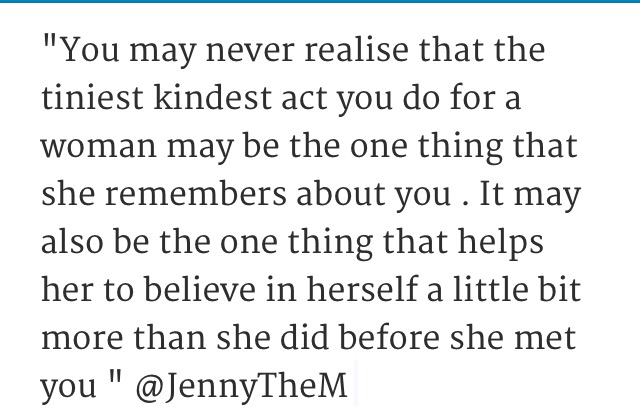
“You may never realise that the tiniest kindest act you do for a woman may be the one thing that she remembers about you . It may also be the one thing that helps her to believe in herself a little bit more than she did before she met you ” 

In the words of the song – it may seem like a mans world – but it would be nothing , NOTHING – without women or girls  – we birth the next generation every single day . 

This blog is dedicated to all the women I have cared for as a midwife . It is also dedicated to my mum Dorothy Guiney , my midwife Jean Duerden and my daughter Jane . You have all taught me , nurtured my midwifery soul and given me strength – thank you so much ❤️
With love, 

Jenny ❤️

NHS

Starting #SkinToSkin contact – What are you waiting for ?

My latest blog is to back up an article published today in The Times about why newborns need to be held by their mothers at birth for as long as possible . The ATAIN study looks at term (a baby born after 37 weeks gestation) admissions to neonatal units and how to avoid them . 


Perhaps it’s time to rethink my strategy – I have been focusing my work on why birth workers should not move the newborn out of skin to skin . NOW I realise that we (that means ALL birth workers) must make our primary aim on STARTING and BEGINING the contact and how to educate women to keep hold of their newborns despite external pressures to move the baby . 

So what are the external pressures? 

As an experiment I have been piloting a scenario project with the pregnant women I come into contact with in my role as a midwife . 

I roll up a clean towel and ask the woman to hold it and say “this is your newborn – I want you to try and imagine yourself tired and vulnerable after a long labour and someone is trying to make you move your baby 👶 out of skin to skin contact ” Then I teach the woman that whilst she is holding her newborn – millions of  physiological things are taking place . These include 

Brain activity in the amygdala 

The newborns tongue is starting to move 

The newborns heart is changing from how it was inside the uterus to extra uterine function 

A connection which is so simple yet at the same time too complex to put into words is beginning – that connection is the most important relationship known to man – the relationship between the mother and her newborn and the newborn and her/his mother . By discussing this I am not trying to disregard the relationship between the child and father or second mother – I am repeating what we know from other mammals that motherly love at birth makes a huge impact on children’s lives and long term mental health . If a child has been taken away from its mother because of circumstance or loss and there is a record showing that SkinToSkin contact occurred imagine the positive feeling this could give ? 

Then I try to explain that we don’t know what we are doing when we forget to begin SkinToSkin contact but we could be meddling with human nature . A baby is so happy in SkinToSkin contact – yet a mother may not be – this is our challenge – to help women to understand why it matters to the newborn . 

Please question your own practice first and then you may enlighten yourself – then try some simple birth scenarios which prevent SkinToSkin from starting – use these to teach women and families – go out and spread the word at every opportunity you can find- make a difference and always think SkinToSkin ❤️

Thank you for reading 

Love , Jenny

ALL MATERIAL HERE TODAY IS COPYRIGHT © owned and created by @JennyTheM you are welcome to photograph but my name @JennyTheM must be visible on all private & public shares by law eg Facebook/ what’s app / twitter / Instagram- please use the #JennyTheM and #SkinToSkin

NHS

Skin to skin and world peace 

Thank you first of all to Natalie Corden ( ‪@corden1326 ‬ on Twitter)  for mentioning world peace in a text to me this week . 

This text got me thinking – what if our behaviours all stemmed from the way we are treated as we are born and when we are held by our birth mothers ? 

Midwives can and do have a huge impact on the way women react to their newborn children . A midwife must show compassion and describe the baby positively to start the love connection and bonding process – for example I say things like “your baby has the most lovely face” and I describe the mouth , eyes, cheeks, nose and forehead depending on what I’m asked – some women don’t want me to talk and I respect their choices . That’s my job as far as I’m concerned . However not all women have been educated on the immense benefits of skin to skin contact . I have been at births where women have changed their mind about not breastfeeding because their baby showed an interest in the breast because of skin to skin contact. These women report not knowing that a baby can crawl to the breast of its birth mother and self latch – they might have been ‘told’ but they may have forgotten- that’s why we have midwives. So, if as a midwife you ask the woman how she intends to feed her baby you are getting it all wrong – it’s not about that – it’s about giving a baby a choice as much as a mum and it’s about waiting , being kind , patience , explanation and compassion . 

If as midwives we say one hour skin to skin has happened how can it be that the birth is registered and the newborn has both an NHS and hospital number within 10-20 minutes of birth ? Are we putting our focus on digital existence not mammalian needs ? I think so . 

Time to rethink the birth registration process I feel . 

So as an experiment I’d like you to question your own interruption of skin to skin for the following reasons 

  • “Time to weigh baby” is that a question ? A rhetorical question ? A command ? Asking for permission ? 
  • “You need to get to the shower” is this what animals do ? Jump in water as soon as possible after birth has happened? 
  • NEED to check baby over  
  • NEED to give baby Vitamin K 

Are the above reasons to interrupt skin to skin contact ? Are they reasons to continue it ? 

Neonate feel less pain in skin to skin , they cry more when non-family members handle them & they know their mothers and their fathers – they don’t know us . 

So the next time you are with a woman and her newborn , is like you to question your own practice . Are you doing it the way you’ve always done it – or are you aware you need to change , be slower , be more patient – and perhaps give that baby a chance of just one breastfeed that might go onto be another breastfeed and another ? 
World peace and world health – just imagine ? 

Thank you for reading.  

With love, 

Jenny ❤️

Birth, Midwife, Midwifery, Midwifery and birth, New parents, Newborn, NHS, Night shifts in the NHS, Obstetrics, Patient care, Postnatal care, Psychology, Student Midwives, Women's health

How to keep your ‘Midwifery Passion’

Ideas to help midwives through NIGHT SHIFTS the past couple of weeks I’ve been on night shifts – hence my temporary disappearance from Twitter . I have been forced to practice self-care and be mindful of my own health and wellbeing in order to not only survive night shifts but also to ensure the women in my care were kept safe. A huge part of my role  is to support women and families and also to be a team player by helping and listening to my colleagues of all disciplines. Factor into this the additional pressure like teaching my body to sleep in the day and stay up all night – all this has an adverse effect on causes on my hormones and body  physiology – so it must be the same for any midwife working the night shift.

 I try my best to visit women who may still be on the postnatal ward (ones that I have cared for in labour or met antenatally) to offer a debriefing session and go through parts of the birth they may have forgotten- I find this helps me as much as it helps them . Women become tired during long nights of labour and may forget their own strength during labour and birth so I like to remind them. As midwives we must make a firm relationship foundation with the woman and her birth partner(s) and we must also display  love for our job and show it’s something we do because we enjoy it not because we have to – when did you last show that you love your job?  Women want to know that you care about them and getting food and drink in the middle of the night is a real challenge but I take it firmly onboard . I scour the fridges for left over unopened  in date sandwiches- dash to the vending machine to buy a packet of fruit pastilles or a small bar of chocolate , offer my pre-packed fruit salad, make toast and encourage food in labour – women use on average 150 kcal an hour in labour and it’s important to explain why you are encouraging eating .  Women don’t want to face a labour with a midwife who hasn’t slept or who is complaining about being at work . My philosophy the past two weeks has been to

  • Get some sunlight every day before bed
  • Eat a meal before work that will sustain me through the night – a balance of protein, carbohydrates and vegetables
  • Laugh with colleagues – I am quite well known ay work for my gangnam style dance so one night I was on the postnatal ward I danced in the office – the future midwives face was picture !!
  • Understand why I may have bouts of moodiness
  • Speak to a friend every other day
  • Walk my dog pre-bed and pre-work to ensure I am getting exercise and fresh air
  • Reduce my screen time – that includes Google and Twitter – I am on screen time at work with the maternity system online and screen time can affect our circadian rhythm.

Don’t underestimate how hard it is for me to get in from work and drive to the beach – I struggle, but I have noticed a definite change in myself during these nights and I am sure its because I have exercised prior to sleeping . I have also used some aromatherapy and mindfulness (which I do every single day – nights or days )

I prepared my fridge – chicken , vegetables , pre-packed fruit portions , cheese for protein in the night , and faced my dislike of drinking water . I googled jet-lag and circadian rhythm to help me face up to how my body might react and went in for the positive approach . I took the decision to walk on the beach with my Labrador puppy Buddie post each shift and eat my favourite breakfast sat outside my favourite cafe before I went to sleep. These positive  activities helped me to switch off from my shift , gave me a sense of wellbeing and also helped me to interact with others before I became a hermit for the day . Once home in bed, all curtains were closed and all lights switched off – as a visual hint to ‘popper inners’ those friends of mine who I adore as they pop in to visit me unannounced and I do love that but not on night shifts. I also prayed that my neighbours would be quiet and that their dog wouldn’t bark too much – it worked !!

Night shifts are special for midwives , the hustle and bustle of the hospital is turned down , the ward round is vanquished, the tea trolley is ever present and I can drink tea in the birth room with the families .

After night shifts it’s ok to feel tired and nap in the day – listen to your body carefully . Take time to recover post nights – don’t push your body beyond its limits thinking you are doing it a favour – you aren’t !

I’d like to dedicate this blog to all the midwives who work night shifts – and especially Olivia and Jude as they often discuss the effects of nights with me –  thank you to all NHS nightworkers  for all you do .

Further reading and resources 

information on The BODY CLOCK 

What is sleep drive ? Sleep drive and your body clock

Try a few of my ideas and see if they help your night shifts – I hope they do .

With kindness & midwifery love ❤️

Your friend Jenny

XxX

NHS

What exactly does a midwife do ?

What does a midwife do ? I was listening to a song on the radio and thinking about my job – what makes me love it like I do ? 

Yes of course I get frustrated but I have such wonderful moments of warmth and happiness – moments which stand still in time for me – as an example when I see a woman become a mother for the first time – when I see a father cry at the sight of his newborn , when I say to the partner of the new mother “GET ON THE BED!!” so he/she transform the bed into the family space and he/she looks at me in surprise – I also see sadness but my role is to make sure that during the sadness important memories are saved , like photographs , pauses in time and to provide reassurance that life will go on. 

I was with a future family a few weeks ago laying the foundations of the beginning of our relationship which would form the basis of labour care when the woman’s mother came in “I was your community midwife !!” I said to her ” you were very busy & I remember fitting in your antenatal appointments around your work commitments ” we hugged and chatted about our children. This wasn’t fate-  it was the universe playing it’s part re-connecting and connecting . 

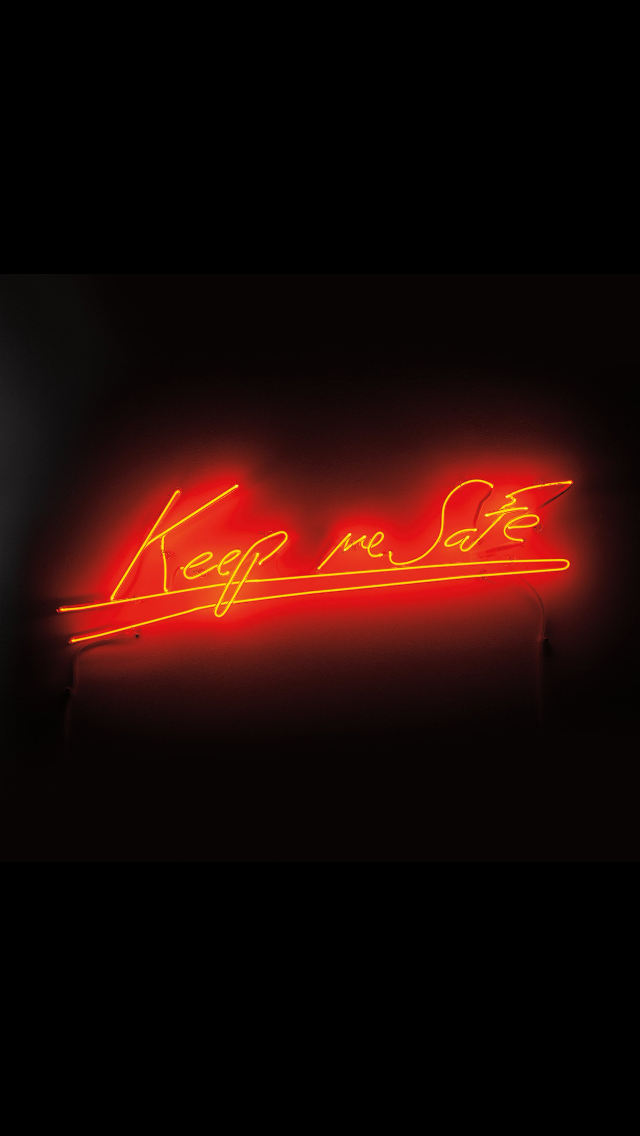
I get to meet new people each day and become their friend , supporter , adviser , informer , personal assistant , carer , room service provider , finder outer , cleaner and enabler . My first aim when I meet a pregnant woman is to become her ally so that she feels safe and able to speak away . Tracey Emin the artist has released a series of neon light pieces and one of them really resonates with what I do as a midwife here it is “Keep me safe” 

Yes I do blood pressures  , palpations , put up infusions , cannulate , take blood tests ,give medications but I focus on the WAY I do these things – I always try to do them with kindness and explanation . Skin to skin contact should be facilitated with explosive kindness – midwives don’t need to touch babies as much as they do – I have now started to question my own practice about this. I see a real change in the behaviour of newborns when I handle them so I ask the partner to place the newborn on the scales in a prone position which reduces stress and crying in the newborn baby (after prolonged skin to skin contact of course!) and I direct the position of the newborn as a hands free situation – if I need to hold a newborn I think first “do I really need to hold this baby ?” And I talk to the newborn first explaining why I am going to hold and ask if that’s ok . 

At the moment there is a cloud over midwifery – will we be able to continue as exclusive care givers to women , families and newborns in pregnancy , birth and the postnatal period ? My answer to this is to ask every midwife in the UK the following  questions… 

“Are you or have you ever practised autonomously ? Have you ever overrid a decision by a consultant or senior obstetrician ? Or have you persuaded an obstetrician to change his/her mind about the plan of  care for a woman ? Have you worked on a birth centre ? Have you questioned why you are a midwife ? Have you looked upon guidelines as GUIDE LINES ? Have you spoken out in the operating theatre when you feel the woman should be holding the baby ? Have you changed a woman’s position in labour in order to facilitate and increased chance of vaginal birth ? Have you avoided man made oxytocin by 1.dimming the lights in the birth room 2.shutting the blinds 3. Not allowing other staff to come into room to look for equipment ? 

If you’ve answered YES to any of OR ALL of these questions – then you are a midwife my friend . 
Thank you for reading , with much love , Jenny ❤️️

Ps as usual I LOVE any feedback ❤️️

Babies, Being busy as a midwife, Birth, Compassion, Courage, Giving information, Helping others, Hospital, Human kindness, Kindness, Labour , birth, Labour and birth, Learning, MatExp, Midwife, Midwifery, Midwifery and birth, Motherhood, New parents, Newborn, NHS, NHS Systems and processes, Obstetrics, Patient care, Respect, Uncategorized, Women's health, Women's rights, Working from the heart

With woman midwifery 

❤️Before I start I’d like to thank Soo Downe for using this photo of me with my pinards in her slides during this years EMA ❤️ &  thanks to Jacque Gerrard RCM for letting me know. 

Hello , are you a midwife ? Have you ever heard or said any of the following sentences ? 

“I’m coming in the office for a few minutes , they don’t want me in there all the time” 

“I’ll leave you in peace for a while – you don’t need me here all the time” 

“I’m giving them some time to themselves whilst she’s in the early stages” 

There is evidence and research to prove unanimously that women who have continuous one to one care have less pain relief , more incidence of normal birth , less perineal trauma and feel more positive about their birth process . As midwives there’s always information to share and explain that the woman may not know about . I also view my role as a guardian to the partner making sure he or she feels involved and free to ask questions . So the next time you hear yourself or a colleague say “I’m leaving the couple I’m caring for as they don’t need me in their birth room all the time” just remember leaving them  isn’t evidence based practice – staying with them totally is 

Resources on continuity 

http://onlinelibrary.wiley.com/store/10.1002/14651858.CD004667.pub5/asset/CD004667.pdf?v=1&t=iwl6t8eo&s=72d734e7de6a3665a8d183e2d5df1492e37dc2ec

http://www.sciencedirect.com/science/article/pii/S0140673616314726

http://www.sciencedirect.com/science/article/pii/S0266613816300572&nbsp;

NHS

Compliance and the art of compassionate rebelliousness 

As humans we are encouraged to comply from the moment we are born . We are weighed , a hat is placed on our head. The media, tradition, education , culture, peers, history and many more all  step into our tiny lives on a huge platform telling us we must not be different 

We hear statements like this every day 

“Does your baby sleep well? ”

“My baby rolls over now does yours? ”

“Are you STILL breastfeeding ?”

“Don’t touch the beautiful fossil on display that was formed millions of years ago – you might break it!!”

“Do your homework” often heard said by parents to 5 years old children 

“Pass you exams and you’ll do well”

“Don’t argue back” 

“Don’t touch , play nice , keep clean , stop asking ‘why?’, sit still, don’t question , clean your room , you’re too quiet , you’re too outspoken , pay your council tax, keep your home clean , revise , work hard , don’t take your dog on the beach , don’t sit on the grass , do not be selfish , speak when you are spoken to , take your medicines ”

I’m not for one minute suggesting that we all dash out and start parking on yellow lines and refuse to pay bills . What I’m trying to say is do we teach our children the art of non-compliance ? Do we actively seek to help them see that it’s ok to say no to to certain things in our life and to put our own selves first ? Do we understand that self care should be 80/ 20 ? 80 for ourselves 20 to others ?Do we encourage that it’s ok to have a different mindset ? 

Now imagine the following statements 

“Hi welcome to our shop , we encourage your children to touch the displays with your support”

“Please find enclosed your contact of employment , within this organisation we actively encourage staff to be radical and challenge our services in order to improve both patient and  staff experience. We do not wish to stand stand still as an organisation  . We evolve only because our staff evolve us”

Change for me 

What exactly sparked my thoughts for this blog ? Well on Satirday I finally got a new mobile phone , I’ve had the same one for four years and I’ve been driving my family crazy . My old mobile would randomly delete tweets as soon as I tried to open them – but strangely the rebel in me quite enjoyed this 😂

On a daily basis I respond to tweets, DM Twitter messages , emails , notifications , questions and phone calls from other midwives (mainly) and future midwives seeking support, guidance ,conversation   , kindness, responses to ideas or a plan to meet up. I  try my best to help others who ask me for help because that’s what being human means to me – to help others  . The text deficit in my life felt a bit good to be honest and then I realised that my family would probably text me more than communicate with me in the methods mentioned above . I was putting others before them – so I got a new phone . 

How strange that @JennyTheM avoided change !! I wasn’t avoiding change I was rebelling against the system for my own good, thinking that one less method of communication may give me some space for self care and mindfulness BUT I was also being blinkered and not opening myself up to the benefits of a new phone . Anyway as usual I have digressed ! (Nothing new there I hear my friends add !) 

So , back to compliance – I was adding the wonderful Whattapp to my new phone and I saw my daughter’s profile picture .The photograph shows my daughter sat eating an ice cream on some grass right next to a sign saying “PLEASE KEEP OFF THE GRASS” – instead of feeling annoyed , embarrassed or wanting to say “why did you do that?!” I felt a surge of pride . My daughter was sat carefully , she wasn’t digging up the grass , she had taken her shoes off and was enjoying a still moment in time  . Here was MY daughter – a rebel . My heart felt so full I just can’t  explain it in words . Here is the photograph 


The NHS and employment compliance 

Within the NHS , current systems mean that we must comply with such things as uniform, behaviour, policies, contacts , orders , emails, training , shift patterns , meal breaks, and also hierarchy . 

Our short lives begin the science of compliance the moment we are born . Girls wear pink , boys blue . I didn’t know I was going to have a daughter when I was pregnant with my first child so I bought baby clothes in every colour but pink . Over the years as I’ve berated myself for my daughters lack of girly outfits as a neonate but NOW I now see that this was due the rebel in me and also my desire to allow my children to be who they wanted to be . My parents did nothing to ‘girlify’ me or my sisters . I was  encouraged that being different was ok . However I wasn’t told by them that being different would cause me to ‘fit out not it in ‘ and also that I would face challenges both in my personal and professional life for my non-conformist ways . I am happy to report that social media has blown this out of the water , I connect with other  of the same ilk . Other  “compassion rebels” determined to care for others in a way that doesn’t always suit the restraining systems of the NHS . PLEASE NOTE that blaming is not my style I have to connect with others that are on the same mission as me . I’ve found my tribe and wow it feels good .  
It’s time for the NHS to value rebels and this is highlighted in the latest release of  ” Let your workers rebel ” published by Harvard Business Review  . It’s so important that parents also stop trying to conform their children into society as individuality is not only what makes us human it is an evolving process and part of humanity  .

Suggested activities 

Read more about rebel behaviour 

Joint the school for health and care radicals  HERE  is the first module 

Get yourself on Twitter and be present in the 21st Century 

Meet up with like minded souls 

Consider blogging 

Keep compassion at your core 
“Fit out don’t fit in” one of my quotes 
Thank you so much for  reading . I would value any feedback ❤️

With kindest love and compassionate rebelliousness 

Jenny ❤️

Ps I leave you with my poem inspired by Natalie Linden’s fab conference in Worthing on the subject of courage in practice 

  Î