Against the odds, Care of the elderly, Change management, Community, Compassion, Courage, Discharge from hospital, Helping others, Hospital, Human kindness, Human rights, Kindness, Learning, Media, NHS, NHS Systems and processes, Patient care, Psychology, Respect, Surgery, Women's health, Women's rights

 The role of L❤️VE in healthcare 

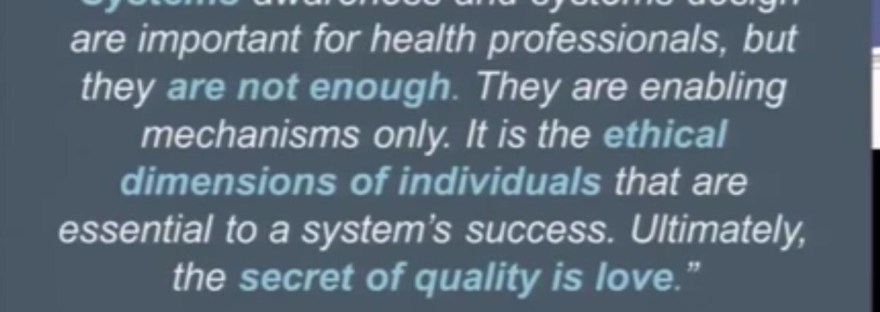
I recently rewatched    THIS FILM   of Dr Donald Berwick giving the keynote speech in London 2013 to The International Forum on Quality and Safety in Healthcare. This presentation struck a chord with me . 

In the NHS there are many systems and processes which promote working within the confines of guidance and staffing  . However, time and time again there seems to be omissions about how guidance can encompass love . When people love their job and they feel valued within their particular role the result is better health care . It can’t be a coincidence that this is because if you love your job then in effect you love the people you care for .  

When we talk about “love” it’s sometimes misunderstood – actually being human is about loving others .

 I was once in an orthopaedic ward as a patient following an accident and had to have major surgery on my lower leg – a pin and plate and internal fixation , tendon repairs . This operation left me non-weight bearing for 12 weeks . My mobility was severely compromised . In the bed next to me was an elderly woman let’s call her “Sophie”. Each day I’d watch some staff forget to put Sophie’s drink within her reach and this troubled me greatly . I’d ask staff to move her drink closer and I was usually given ‘the look’ i.e “what business is it of yours?” In fact it was totally my business as a human to care about another human . So I made a decision that I’d make Sophie’s hydration my job and also the job of my visitors . Sophie had no visitors , she was confused and didn’t really talk much . I asked my family to bring her a few bottles of sugar free cordial and set about my mission . On a daily basis I hopped to her bed and made her several drinks over the course of the day – usually out of sight of the staff . I began to recognise when she wanted the toilet as she’d shout out , then I’d alert the staff . This went on over about 6 days and with my visitors helping Sophie was soon rehydrated and talking – in fact she was well enough to go back to the nursing home she had been admitted from . 

So what made me do this ? I didn’t know Sophie and I could’ve just focused on my own recovery. In fact Sophie helped me to find the courage to use my crutches (something I was petrified of using) and she took my mind off my own pain and frustration . Much more than this however I saw myself as Sophie in years to come – ‘sat out’ in a chair unable to move or communicate , hoping for the staff to be kind , for the kindness of strangers to aid my recovery or to ease my loneliness in some way . 

“We are all one another” 

I never told anyone about this before except my family who were also directly responsible for Sophie’s recovery . You see the truth is we didn’t do it for recognition – we de it because we are human 

Thank you for reading 

With love , Jenny ❤️
Against the odds, Care of the elderly, Community, Compassion, Courage, Fables, Helping others, Hospital, Human kindness, Human rights, Kindness, Learning, MatExp, Midwife, Midwifery, New parents, Newborn, Newborn attachment, NHS Systems and processes, Patient care, Psychology, Respect, Teaching, Women's health, Working from the heart

The fable of the napkin folder 

There was once a factory in a far away land . The factory owner Fred  took immense pride in his factory .

This was no normal place to work , the employees had to fold napkins at the same time as caring for an elderly person . This care involved mainly talking to the elderly person and making the person happy through conversation – this was an intrinsic  part of their work – but I’d like you remember that  the employee also had to fold napkins .

Suki was an employee at the factory , she was an amazing napkin folder and the top napkin folder at the factory . The factory owner raved on and on about how good Suki was at her job – he promoted her and used her as a role model of efficiency whenever he went to other napkin folding factories . Suki felt very proud and kept working hard .

One day Suki’s chair broke – so she had to move to another area whilst it was fixed . Suki sat next to Giles who was also a napkin folder – Giles wasn’t very productive but he did attain adequate levels of napkin folding  to keep himself in employment . Suki noticed amazing things about Giles he was working but also chatting away to his allocated elderly person quite a lot , the elderly person was called Gertrude . Suki noticed that Gertrude looked very happy and Suki suddenly realised that all the years at the napkin folding factory her own allocated elderly person had never laughed like Gertrude . 

The next day Suki went to see Fred the factory manager and told him about Giles & Gertrude . “I think we should watch Giles” Suki said . Fred the factory owner went to see Giles and immediately noticed how joyful he was in his work – Suki was happy but Giles had that extra ‘je ne sais quoi’ . The factory owner also checked all the records of all the elderly people that Giles had sat with whilst he folded napkins . A wonderful thing had come to light not only had no one complained but there were letters of thanks from families of the elderly people stating how kind Giles had been and recommendations for his promotion .

The next day Fred the factory owner made an announcement to all the people at the factory  

“All of us within this factory should give a higher priority to making each elderly person happy  over and above folding napkins. In this wonderful life  we are simply spreading kindness , compassion and the human spirit . Look at Giles and Getrude and the happiness they emit and share . ”

Over the next few months the factory workers tried their best each day to give their priority to each of their allocated elderly people. A remarkable thing started to happen – productivity increased and surprise,y more napkins were folded than ever before  but also the workers felt more valued  and much happier about being at work – plus much more than that the physical and mental health of the elderly people involved took a significant improvement – because in the end we are on earth to be human .

I hope you enjoy my fable . 
Thank you for reading 
❤️Jenny❤️

Babies, Being busy as a midwife, Birth, Breastfeeding, Caesarean section, Care of the elderly, Change management, Children, Community care, Compassion, Courage, Helping others, Hospital, Human rights, Kindness, Labour and birth, Learning, Media, Midwife, Midwifery, Midwifery and birth, New parents, Newborn, Newborn attachment, NHS, NHS Systems and processes, Nursing, Obstetrics, Patient care, Respect, Surgery, Teaching, Women's health, Young mothers, Young women

#LeadToAdd 

LeadToAdd click HERE to learn more is the latest NHS England campaign # is #LeadToAdd. As a Caremaker I will be linking this on Twitter with my work on #skinToskin , #futuremidwives and #couragebutter to inspire others to see themselves as leaders regardless of their role . Patients, women, families and non-clinical staff are also leaders .  
I feel this will inspire/activate different meanings to different people

Here are some of my thoughts around it

What does to lead mean ? 
To take charge , to be at the front , to inspire , to educate, to be diverse 
Leading is about being at the front and CONSTANTLY looking back to bring others with you

Leading is about being the first to begin something but not necessarily holding onto that but looking at how your actions impact on the way others fulfil their role. Leading is being a positive role model, leading is about looking inwards at your own behaviour and also looking outwards at the behaviour of others . 

In the NHS all staff need encouragement to recognise themselves as leaders and also to see that some behaviours do not embody leadership. We are all learning each day, so don’t stay still – question yourself and the way you speak to others . Ask a colleague to listen to you talking to patients and staff and to give you feedback -what could you change ? Integrate telephone conversations into drills training-  talk to your practice development team – think outside the box . 

Someone who leads others into poor practice is a poor leader but a leader non the less so be aware of your own commitment to pass the positive leadership baton . We are human and it’s ok to make mistakes , however we must learn, evolve and change .

The other day I had a car journey with Joan Pons Laplana (@ThebestJoan on twitter) and once again he made me think hard about how the 6Cs are integrated into practice . Joan said to me that as a health care professional all tasks and procedures must embody the 6Cs – even answering a telephone call. 
As a form of reflection I’d like you to read passage one and then passage two
Passage One 
Busy labour ward – phone ringing , midwife answered the phone – we will call the person making the call Tony and his partner who is having a baby is called Dolores. The midwives name will be Darcy . 
Midwife ( confident and cheery) ” hello labour ward , midwife speaking how can I help you?”
Tony (nervous voice) ” oh hi – err my partner thinks she’s in labour , it’s our first baby and we are a bit nervous . Could I ask you some questions , she’s here but having a contraction right now and then she feels sick for a few minutes after its gone. 
Midwife “oh right well I need to talk to her please and decide what’s happening’  
I’m not going to continue this but could the midwife change her approach ? Is this midwife you ? A colleague? This approach has been learnt from a peer
Passage Two 

Busy labour ward – phone ringing , midwife answered the phone – we will call the person making the call Tony and his partner who is having a baby is called Dolores. The midwives name will be Darcy . ….

Midwife ( confident and cheery) ” hello labour ward , my name is Darcy Jones I’m a midwife and how can I help you?”
Tony (nervous voice) ” oh hi Darcy – I’m Tony – err my partner Dolores thinks she’s in labour , it’s our first baby and we are a bit nervous . Could I ask you some questions , she’s here but having a contraction right now and then she feels sick for a few minutes after its gone. 
Midwife “ok well I would like to take some details first whilst Dolores has a contraction . Thank you so much for ringing us . How are you feeling ? This is your first baby ? How exciting for you both!” 
I’m not going to continue this but could the midwife change her approach In either scenario – which is the best one in your opinion ?  ? Is either of these scenarios you ? A colleague? This approach has been learnt from a peer. 
So you see two examples each one leaving the person contacting  the service with different emotions . 
Start your journey as a #LeadToAdd leader today  ❤️
Thank you for reading 
Love , Jenny ❤️

Antenatal education, Babies, Being busy as a midwife, Birth, Breastfeeding, Caesarean section, Change management, Children, Compassion, Courage, Helping others, Hospital, Human rights, Intra-operative care, Kindness, Labour and birth, Learning, Manual removal of the placenta, MatExp, Media, Midwife, Midwifery, Midwifery and birth, New parents, Newborn, Newborn attachment, NHS, NHS Systems and processes, Obstetrics, Patient care, Post traumatic stress disorder, Postnatal care, Respect, Skin to skin contact, Surgery, Teaching, Women's health, Women's rights, Young mothers, Young women

The natural caesarean / the gentle caesarean 

There’s a debate on Twitter this morning about the ‘natural caesarean’ as a term that promotes a positive experience of birth by caesarean. I don’t agree with the term and I think as health care professionals working in the area of birth we should ensure that every birth is a positive birth . Milli Hill started the The Positive Birth Movement  with this goal in mind (@birthpositive on Twitter ) 

Bearing this in mind I’d like to ask the following questions for you to consider and share with with your colleagues, family , friends , midwives and obstetricians . 
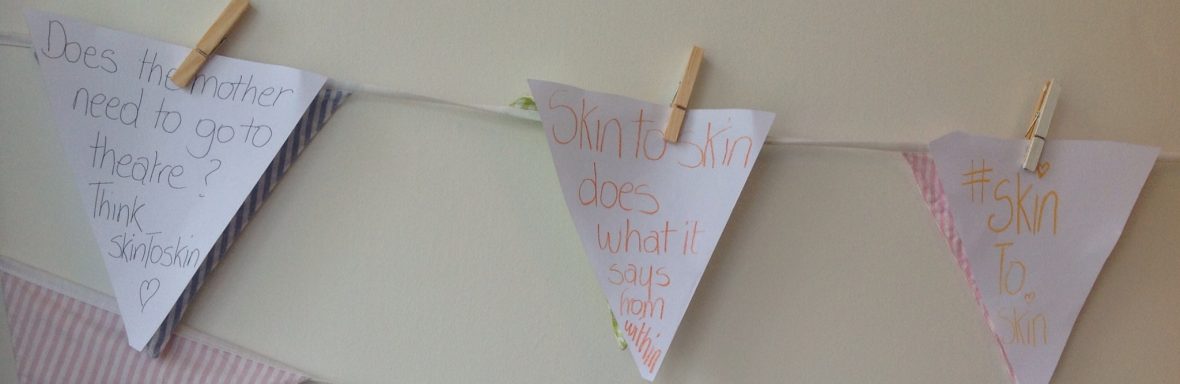
1. How many women who have an emergency caeserean and/or instrumental birth (forceps or ventouse) are given information in the antenatal period about the far reaching health and psychological benefits of skin to skin contact in this setting to both mother and baby ? 

2. Compare the above with how many women are given information about  skin to skin contact around normal birth ? 

3. Compare both to how many woman are informed that skin to skin is possible during manual removal of placenta and repair of any perineal trauma in the theatre setting ? 

4. Are women informed 

  • They can TELL midwives to defer the weighing of their newborn in order to enjoy the benefits of prolonged skin to skin contact 
  • That they should never be separated from their baby unless a clinical situation becomes apparent or they themselves choose not to have skin to skin contact despite being FULLY informed
  • That their baby could ‘self latch’ at the breast without any handling by staff and also correct its own acidosis and stabilise its own breathing because of skin to skin contact ? 
  • That skin to skin and early breastfeeding “Pronurturance ” is linked to a reduction in the incidence of  postpartum haemorrhage?  CLICK RIGHT HERE for the Pronurturance paper 
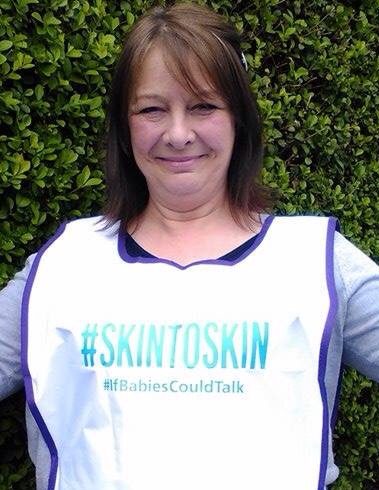
  • That if babies could talk they would choose skin to skin contact despite their birth environment 
  • That skin to skin contact is the building block for a persons social and psychological development 

The midwives and staff on social media who talk about caesarean are not promoters of it , they are giving women information about choice – so that if the operation (which is major surgery) does take place then these women are able to not only enjoy their birth experience but give their relationship with their baby the best possible start . 

I suppose it’s similar to the question “does having a teenage pregnancy strategy increase teenage pregnancy rates ?  (and I much prefer the term  “young women”to ‘teenage pregnancy’) 

Does having full information about your choices if you do go on to have a caeserean increase caesarean rates ? I don’t know the answer to either of these questions but I do know that the women I have assisted and sometimes fought for to have skin to skin contact with their newborns in different birth situations have all told me this 

 
-that they never realised the positive impact it had on them as a successful mother

To me this is enough .   
Thank you for reading 

With love , Jenny ❤️

I am also promoting #MatExp as a platform which enables and encourages discussion between women, families and health care professionals .