

Blog

Midwifery and birth, NHS

WaterBirth

I am a physiological midwife . I promote the use of water in pregnancy, labour and also birth . I have not always been this way – I’ve read and studied the effect water can have on us as humans and in the past ten years I have developed a belief and understanding about the benefits of using water to calm, relax and strengthen. Some women are uncertain about the role that water can play in their labour. I discuss the benefits and try to imagine myself as a future mother listening to my views and my passion for birth in water.
At no point do I ever force anyone to get into the water. However I always admit a woman to a room with a pool and try to have the water running as she enters the room . There is something calming and reassuring about the sound of running water – memories of bath time as a child are evoked. Water has long been used to cleanse, relax and prepare for rest as well as helping us as humans to start our day . Washing and bathing are such a huge part of our lives that we give no thought to them – water is primitive . Think of lakes pools, rivers- places where our ancestors would wash, play, perform ritual, religious ceremonies and do chores- water is embedded into our psyche. Water makes is feel good and this is highlighted in the following article.
http://www.theguardian.com/sustainable-business/impact-sea-lakes-rivers-peoples-health
We are drawn to water – the Lake District is named after water , there are many places in the world infamous because they have involve water – hot springs , falls, rivers and streams . We marvel at the strength and beauty of a waterfall, at the gentleness of morning dew on a spiders web and how many of us have stared at the sun setting on the horizon and disappearing from view as if appears to submerge itself into water.

20140809-063603.jpg

Being in a pool gives a woman her own environment – mammals seek a safe place to birth away from other mammals, predators and noise . They seek somewhere secure, warm and calm- a protective place. The pool environment fits all these criteria and more – compare a pool to a bed – there is in fact more privacy in the pool – once inside the pool a woman is covered by water and her private areas are away from view. Consider this in relation to a woman on a bed with a sheet over her and feel her vulnerability in this position. Staff stand over her and instantly the inequality begins – whereas in a pool a midwife will sit on the floor , kneel down and bring herself to the woman’s level – if you are with a woman who is on a bed then gets chairs for other HCPs who may enter the room , make sure the correct door is opened to maintain privacy and dignity , make the bed higher so the woman feels at a positional advantage or help her to get off the bed off the bed http://www.rcmnormalbirth.org.uk/ten-top-tips/

I call the pool the “watercave”and women I have talked to after the birth say they felt safe strong and protected by the walls of the pool , they felt they could move and choose their own position and in control of their own movements . As the birth process begins I’ve noticed that more women feel for the babies head in the pool than on a bed – I never ask a woman if she would like to feel her newborns head prior to birth as it should be an instinctual choice – once we say , are we interfering? I talk to women and their birth partners about the physiology of birth in the pool, how it happens and about physiological third stage . I feel as health professionals we should not presume prior knowledge and that discussing birth choices builds on the relationship between the family and the midwife . We should feel equal and the same – this will facilitate a two way process of communication and care and will also embed the 6cs in order to give the best experience to the woman primary not the midwife .
The most wonderful thing about the pool is that the midwife learns to sit on her hands there is no need to touch anything and this is just amazing for the woman .
To see a woman reach down and lift her own child out of the water (or for the father / second mother / grandparent / partner / friend to
do this) is just so beautiful it is the land of goosebumps the place where birth belongs and when you facilitate this you are giving birth back to women. Midwives are “with woman” WITH suggests equality – we are not superior to women and we should rejoice in the power of the uterus and the power of womanhood in its own right.

20140809-074917.jpg

20140809-075924.jpg

IMG_4029.JPG

Midwifery and birth, NHS

With woman

💛Midwife means with with woman .
There is so much depth to this word – it doesn’t just mean that as a midwife you are present at a birth but so much more.
To me “with woman” means you are “with the women of the world with your every breath” – it means you believe in compassion, feminism, women in society , the future of humanity and life itself
Today I started thinking (ooh look out when Jenny The M starts to think!) what if…….
There were no womankind
no births
no midwives
where would the world be?

Women are the backbone of society but somehow in its own delusion society has slightly forgotten all this. Emily Pankhurst fought with her comrades to get women the vote – yet female authors hide behind a male name

Being with a woman in labour who is single and labouring alone -you take on the role of a friend as well as a midwife and I defy any midwife not to feel like this.
Midwifery is all about women and that doesn’t mean that male midwives can’t be feminists too after all they like us were ‘brought up and raised’ in the organ that rocks – the female uterus
Does society truly value the fact that women give birth? Do midwives realise the implications that a child’s birth has on the mother and the child ? Does society see the effect birth has on the earth?

See the strength and courage in women who suffer from domestic violence- imagine the fear a woman feels in such a relationship and her shame to admit it to anyone

Embrace the power of many women who support their female friend whether she is grieving, being bullied , giving birth or facing challenges – women rush to other women’s aid.

We are one voice and we have to remember this every single day
So each day I get out of my bed I say to myself ” I am a strong woman, I am proud to be a woman and know other women who are strong. I will help any woman who may need my help and support today ” help and support may just be a chat, a reassuring hand on a shoulder or it may mean a hug , a way to help change a situation or a way to get help from someone else . So if you are working with women , as a midwife or in a role where you are in contact with women – just focus on how amazing women are and where the world would be without them – give support – be womankind

20140719-212604.jpg

20140719-212632.jpg

This post is dedicated to my friend – a strong courageous woman

Midwifery and birth, NHS

Birth by caesarean

I’m writing today about birth by caesarean . I want to try and make everyone who visits my blog arrive with an open mind and leave after reading it with a fresh perspective. 💭

“If we do what we have always done there is no change there is no development things stay the same” (by me 📝)

Operating theatres have to be sterile, organised and have processes for risk in place – safety is paramount . At the heart of the operating theatre is the patient – the staff do their job every single day it is a routine to them – running an infusion through, ensuring the sterility of instruments, making sure that the staff present are trained and that the correct checks have taken place. Al these things take place prior to the patient entering theatre.
I would like you to consider this – we come to work to do our job, we love our job and if not for the patient we would not have a job – do we see the patient as our employer ? In an indirect way the patient is our employer and yet simultaneously our customer . If our customer and employer has a good experience they will not always shout it from the rooftops as much as if they have a bad experience – so we must put this thought into our heads daily – a bad experience is more likely to be shared than a good experience.

As an independent human you access food, drink and warmth whenever you want it – you are thirsty so you get a drink you need food so you eat – if you ever become a patient the ability to do this stops or reduces – you cannot access food immediately, you have to ask for a warm drink and also you may have to ask to use the toilet 🚽. Your have to ask to satisfy your basic needs. These are some of the hard parts about becoming a patient – to access these things that you took for granted which you never considered you have to call another human by pressing a buzzer or asking permission. Add to this the fact that you may have had an operation or an illness which has compromised your ability to mobilise , access pain relief and compromised your high standards of hygiene . I’m not trying to influence your thoughts I just want you to think about these things.

Who does an NHS Women’s Unit theatre belong to ? In my eyes it belongs to Women so this means that NHS staff are the guardians of it . The theatre environment is very white bright and clinical because it’s always been that way – hang on “because it’s always been that way ?” Well let’s try to change that – why can’t we have paintings on the walls which are part of the wall ? imagine lying on a theatre bed staring into a blank void or imagine looking at a beautiful scene above you – which would you prefer?

A woman enters theatre knowing this will be the birthplace of her child. Her individuality has been removed by placing her into a generic gown removing her jewellery and make-up All the people in theatre will share the event of her child’s birth. The first thing that she sees are staff in pale blue gowns, masks and hats with only eyes peering out. The ability to communicate is lessened and there is a sense of stage and routine . Instruments on the trolley been arranged in place neatly ready for her operation to begin. If the woman is wheeled in she feels vulnerable and compliant on her hospital bed whilst others look upon her .

20140816-152248.jpg</

“All the world’s a stage,
And all the men and women merely players;
They have their exits and their entrances,
And one man in his time plays many parts,
His acts being seven ages. At first, the infant
…….”
William Shakespeare

We have one thing in common we are all born we all die . I am passionate that women who give birth in theatre either by Caesarean section or by forceps or ventouse are facilitated to feel as positive about their birth as women who give birth without intervention. I also want you to question your own units practices – do women who may require a manual removal of their placenta hold their babies routinely ? Do women who may have to have a repair of perineal trauma in theatre routinely hold their babies ?

The culture of the staff in the operating theatre is one of the largest barriers to skin to skin care taking place after a woman has undergone a Caesarean. Several clinicians have reported the implementation of immediate skin-to-skin care (within 30 minutes after birth) in their hospitals’ operating rooms (Smith, Plaat et al. 2008; Hung and Berg 2011) The authors noted that operating room staff members were initially skeptical, reluctant, and afraid to change their routine habits and behaviors. But after seeing the benefits of this family-friendly procedure, staff became supportive of the change
– read this link for further references http://evidencebasedbirth.com/the-evidence-for-skin-to-skin-care-after-a-cesarean/

If every HCP in the theatre setting considered the promotion and facilitation of skin to skin in theatre as intrinsic part of their role – rates would soar and women and babies would be shouting from the rooftops . Patchiness is no good – just the other day I asked about the “Theatre list” and was sad to hear that two women and their babies did not have skin to skin discussed with them – Jenny The M can’t be everywhere – if only I could be like a fairy and zip into theatre with my wings and dust skin to skin thoughts on everyone around – imagine 💡.Read the following about cHange by Helen Bevan and Steve Fairman

NHS Change and transformation – Helen Bevan and Steve Fairman </a.

the NHS thrives on change it’s time to lose tradition and focus on the new – this is a slide I made for a presentation about optimal and appropriate use of an area – to do with Competence and the 6cs and it applies to any area involved in Women’s Health

It can be applied to the theatre setting and also to the process of skin to skin contact – so please please if you work in theatre and come into contact with a woman who may have to have a caesarean ask her if someone has discussed skin to skin contact and if they have not make it your goal to do this

Be rebellious for women out there – we are a crucial and core part of society and humankind – being rebellious for a woman’s cause shows courage and will have a profound effect on that persons life and first experiences.be a rebel
You might fear rejection but eventually you’ll get noticed and people will start to follow your lead and do the same 💡

20140827-121046.jpg

I know where the skin to skin fairy lives

20140827-121737.jpg

20140827-121748.jpg

If you think you can’t make a difference just search #skinToSkin on twitter – 💕

Skin to skin

@JennyTheM

Midwifery and birth, NHS

Breathing , visualisation and psychoprophylaxis for labour and birth

Breathing through labour why is it beneficial ? Here’s how I explain it to women I meet
The Cervix
The cervix is an extension and integral part of the uterus – I recall learning about the cervix parrot fashion ‘finger like projection from the uterus’ . I uses the analogy of a ‘balloons tie’ for the cervix – a ‘balloons tie’ is holding in the air – the cervix is maintaining the integrity of the membranes – except it’s tightly closed not tied . The cervix is very vascular and has a mesh of nerves supplying it – hence it is very sensitive rich in blood supply .
A tightening / surge or contraction begins in the pacemaker(top) of the uterus situated close to the fundus and sends the signal down to push the baby’s presenting part onto the cervix which hopefully will cause it to efface and then dilate. This process is faster in subsequent pregnancies and may take hours in the first labour – no one really knows how long anyone’s labour will last-how fast-how slow – but breathing correctly can make a difference to the way it is approached and managed by you (by YOU I mean the woman) A lot of women I meet think they should feel pain high up in their abdomen and when I explain they are quite surprised but delighted.

20140706-145451.jpg

The pressure of the presenting part on the cervix leads to discomfort and this is due in part to an ischaemic (lack of oxygen) effect on the cervix – for example press hard on the palm of your hand with one finger then watch the skin go white then quickly return to a normal colour – this is capillary refill time – the time when the area is white is when the oxygen and blood supply is diminished . Now imagine that in context to the cervix which is a lot more vascular and nerve enriched than the hand . If a woman learns how to relax through pain and breathe deeply staying calm absolving stress the pain will be reduced . I’m not waffling, I talk and teach women this technique daily. I’ve had comments such as ” how did you do that ?” “Thank you I feel better ” – but in fact I’ve done nothing they have done it all themselves . A major part of breathing is the ‘art of visualisation’ the ability to close your eyes and see in your mind what is happening – this gives focus and assists the woman in the process . I say “if you are saying ‘I’m allowing myself to efface and dilate’ then you are believing more in the process – calmness mindfulness and self-belief will all assist and make the journey less arduous .
Effacement and Dilatation
How to describe dilatation and effacement? You cannot see this body mechanism so I thought of a polo-neck jumper – before it is pulled onto the presenting part(pp) the polo-neck (cervix) is un-effaced , as it is pulled onto the pp the polo-neck(cervix) is starting to efface . As the top of the polo-neck (cervix) reaches the pp dilatation begins

So here is an example of a surge/contraction/tightening

“Your cervical pressure is starting – stay calm focus on your calmness, the beauty of your unborn child and visualise your cervix being pressed and the oxygen you are breathing in rushing to replace the oxygen that is being pressed out – you are fantastic – believe in your body – breathe deep , allow yourself to dilate and relax “think of this like climbing a hill the happiness in your heart you feel as you reach the top (height of surge) then run down (surge reducing) this breaks the discomfort into manageable parts . All the time this is happening it is crucial that there is minimal disturbance 1.no-one entering or leaving room 2. Calm ‘generic’ music with no beat 3. Supporters who believe in the woman 3. Low lights – in other words tranquility – other mammals go to seek out quiet places where they cannot be disturbed and so we as midwives must make this happen for women. Interruptions stop the flow of oxytocin and can lead to an increase in intervention

This technique can be used throughout labour and also with the use of gas and air and is also helpful in a pool or even during a vaginal examination – but I feel that woman should be offered gas and air during examinations must be given the choice to do so.

A happy positive approach to labour and birth as well as intricate and detailed communication will give women strength . Knowledge of her body will give her the ability to entrust in her own body

My son has just asked to read this and said he’s found it interesting and can see that it would work. My inspiration for this blog comes from the women I meet every day that believe in themselves plus their supportive birth partners who take my words on board and continue to support their partners through labour- from the latent phase, right through to the birth of their wondrous children . Also thank you to the student midwives I work with who have encouraged me to write about the way I teach ‘breathing’

Breathe,Relax,Calm,Believe,Visualise and interrupt NOT!

Uncategorized

Antenatal education

I offered to run the group for two sessions for one of the midwifery teams . The last time I’d “led” a group was in the late 90s since those years have slipped by I’ve gained courage knowledge and insight into how normal birth can actually be .
I agreed to be there with a student and was told there’d be about 8 couples so approx 16 people. I arrived with lots of things to handout and felt nervous but excited as I love meeting new people. In fact there were 14 couples
The staff at the children’s centre where the group was held were amazing – they’d set up drinks and snacks in the middle of the room and it was a friendly relaxed atmosphere.
The people arrived- “future parents” all excited about learning but at the same time doubting their own abilities – my job was to make them leave the group feeling and thinking differently than when they came. I really wanted to give them a thirst to seek out more information .
I promised them all I’d do my best to give evidence based advice and that I’d back it up with written evidence so they could read about it afterwards . I also gave out mum and baby care plans that have information in about signs and symptoms of illness , postnatal recovery , investigations , discharge planning and what midwives check for after the birth – I did this as sometimes these documents are rarely looked at by parents until they go home and I wanted them to see in advance their packages of care to make it all more real and current.
I put my phone on silent and on the table upside down the first thing someone said to me was “Skin To Skin Switches on babies brains?”

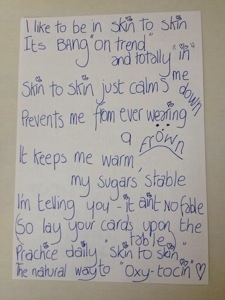
20140629-204158.jpg – so I then launched into the benefits of skin to skin and they were hooked.
I made sure I stopped every 8-10 minutes to allow questions and gave out post-it notes for questions – we laughed together practising breathing techniques and we also became emotional when we all discussed mental health issues and I talked about my own experience of post-natal depression . Putting myself in the spotlight was quite tough but I just knew that if I said it they’d accept it’s existence- in some small way this might just break the stigma around mental health.

The group were soon bonding and the characters surfaced – “Jenny you do realise next week England are playing ?” …..but hang on this is your first baby ? but then I said let’s have a plan and make the class earlier – I kept thinking that it’s good to be flexible in all matters around birth so why not times of the group?
We all chatted and laughed -I learnt about their hopes for birth. My aspiration was that in some way I had helped to dissolve their fears and turn them into courage for labour and an ability to believe in their bodies – my parting quote for week one was “no-one knows how any of you will give birth but we don’t worry about other mammals giving birth – you need to read up what I’ve given you, feel your own strength by recognising how amazing the human body is and give yourselves the best chance for a normal birth . A positive mind is a true gift ”

Week two -arrived and I was so thrilled that everyone had arrived- in the back of my mind perhaps my conscience was telling me that only half the group would arrive – they wanted more – and so did I .
We recapped on the first week and they all excitedly told me how nice it was to read the care plans and think about their babies – we then talked about One Born Every Minute as there was a Hypnobirth on this particular week and they were all really amazed but also said that the birth had backed up what I talked about the week before i.e. believing in their abilities (never thought I’d be discussing OBEM ! Then skin to skin came up and some had asked their parents about it and really researched the subject (proud!) – we staged a mini production called “I need skin to skin” in which another health professional enters the room after the woman has given birth and tries to move the baby – I really felt amazed by their power and passion for skin to skin – my little signs around the place on post it notes, my phone cover and even mini stickers had worked !
We revisited breathing and all had a huge attack of hysterical laughter – but I liked this very much as I imagined them breathing in labour and recalling the laughs they had with me.

20140629-212723.jpg

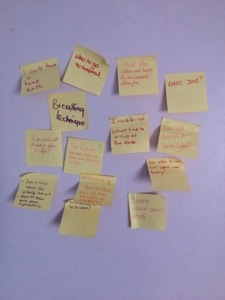
Eventually it was time to prepare to close the group – I asked for post-it notes with anything on they felt relevant and this was the result

20140629-212935.jpg

The best part was at the end when they all came to hug me and tell me that they were ready – I felt like a proud mother hen sending her chicks out into the world – and I knew they’d all be fine

I’d like to thank Student Midwife Gemma Whiteside for coming to the first group with me and being such a great student ( she was off that week and revising for exams = commitment!) Also the staff at The Children’s Centre – you know who you are ( turns out one of these lovely ladies is pregnant and she only told me at the end of the second week !)

Thank you to all the nameless couples who I laughed with, learnt from and bonded with – I know you are all going to be amazing in labour and even more wonderful as parents

20140629-213717.jpg

20140629-213728.jpg

Midwifery and birth, NHS

#skinToSkin my personal pilgrimage for babies and women

Today I’m up full of vim and vigour and decided it’s about time I explained my passion for skin to skin contact for babies. I was lucky enough to hear Dr Nils Bergman talk just over 6 years ago . I have always promoted skin to skin contact at birth as I am aware and fully conversant in The Ten Steps To Successful BreastFeeding by UNICEF . I am a fully fledged Key Trainer in BreastFeeding support – if anyone is having concerns or difficulties with BreastFeeding my first words are always skin to skin : )
I was however guilty of perhaps promoting skin to skin more for women who were keen to breastfeed and wonder now how many opportunities were missed because of my somewhat blinkered approach . As Sheena Byrom states regularly ” we are all learning ” (continually ) and if we don’t learn or stop learning we don’t develop, our gift to inspire is lost and the world will remain static – the quote by Gandhi “Be The Change You Wish To See In The World” helps me daily . I use the current tense as my journey is not a destination it is a pilgrimage to a nirvana (a state of blissful egolessness) where mothers will know all the benefits of skin to skin contact and be courageous enough to say they will be having skin to skin contact not “I’d like it” “if it’s possible” ” I’d like to try ” etc
Back to Dr Bergman – the moment you hear something that changes everything in your mind is described as a “lightbulb moment ” and that my friends is exactly what happened to me but first I had to test this theory and consolidate the evidence Nils had presented . Strangely enough within two days I was at work and with a woman who was having a Caesarean section for twins – the neonatal unit was closed. There were concerns about neonatal hypoglycaemia and hypothermia so I chatted to the mother about skin to skin contact and showed her the evidence that Nils had presented (women like to see facts so bear this in mind if you are ever trying to explain anything) she asked me to start skin to skin as soon as possible after her babies were born. The following is from my reflective piece that was written and sent to the North West Infant feeding coordinator

‘I facilitated skin to skin contact for both babies by fashioning a kangaroo system with a large soft cotton blanket . The blood sugars of the babies rose from an average of 6.1 to an average of 8.5 . The temperatures stayed normal and one of the twins that had some tachypnoea and grunting developed a normal respiratory pattern – the paediatrician had never seen this and was amazed . Both twins were prone but I never left the room so was able to continually observe their temperature respiration and heart rate . The woman had chosen to feed artificially – but it was incredible to see one twin crawling up her chest . She really enjoyed the experience and her partner and the twins grandmother took lots of photographs . I did not weigh the twins for a while and not until they were both settled this took less than one minute – skin to skin contact was just over 3 hours in total’

From that moment on I became a skin to skin addict and I was shouting from the rooftops about the benefits , the happiness it gave woman and stability it gave babies – so I started to look at skin to skin in different settings , promoting skin to skin regardless of type of feeding and networking with women staff and organisations.

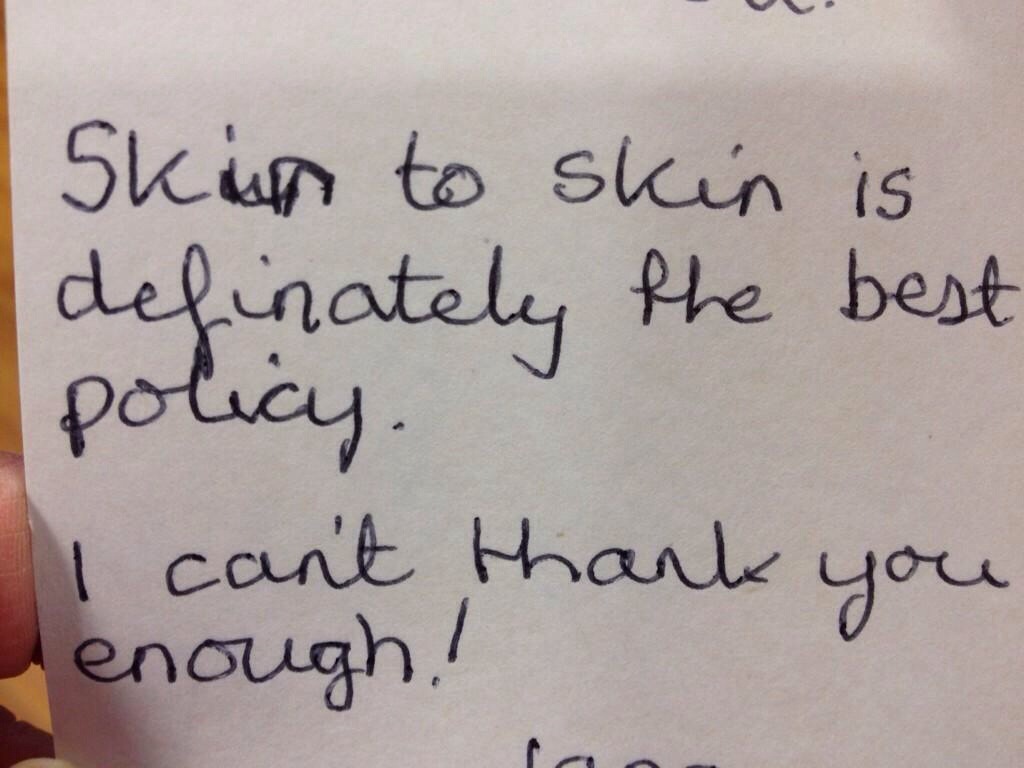
Believe me when I say it’s not been easy and it won’t be – I’ve got myself into trouble at work for writing on a blank wall in theatre directly above the WHO checklist board “IS THE BABY IN SKIN TO SKIN” in large black letter with a huge heart on either side. I’m not saying you should all rush out and do that . What matters is raising the profile of skin to skin and with lots of support from my managers, colleagues and friends at work we are all making a difference within the NHS for babies to have a better start . All I’m saying is SO CAN YOU ! I put ‘skin to skin’ in tiny writing everywhere and I feel a bit like a skin to skin brainwasher staff say ‘ skin to skin’ to me all the time and I use it as a greeting or a way of saying good bye – it’s become my ‘high five’

Now onto twitter – TWITTER ! – initially I tweeted about my bears Billy & Bessie – which were bought to help a friend with severe depression. As most midwives know my ‘inner midwife’ tempted to peek at other midwifery related tweets and then I started thinking whether I could promote skin to skin globally by ‘harping on’ about it like I do at work and JennyTheM which was initially meant to mean Jenny the Mother – now means mother Midwife and Maven (with thanks to @Twidmife )

Twitter is the fastest way of seeing what’s happening in the world – whether it’s health , news , research , information and it’s got MASSIVE implications as it’s NOW ! I regularly go into work in the morning and tell a colleague about some news I’ve seen on twitter before I’ve even read a newspaper or heard the radio so please find your passion and tweet, enjoy, share and inspire

I’d especially like to say that I’ve gained courage from twitter and that the indomitable Sheena Byrom is always helping on my beautiful scenic pilgrimage to learn every day . Sheena has promoted the twitter buddy system and if you don’t follow her please do – also Florence Wilcock from Kingston hospital a truly family centred obstetrician who is spreading the skin to skin word within the team at her trust . The heads of midwifery that I follow and the student midwives who amaze me and are so 21st C modern kind and passionate , Anna Byrom at UCLAN for giving me a fantastic opportunity to present with music dance and laughter Jennifer Hicken (Great NorthMum) for inspiring me and believing in skin to skin and the people who are not NHS staff such as Annie McNamara, Ray Wilkins, Jo Platt and Duncan Richardson (for hedgehog info and moth phobia therapy) – you all keep me going make me smile and encourage skin to skin to ‘go viral ‘ ….. If there’s anyone I’ve missed please think this every single tweet I’ve read has affected me in a positive way and is helping all babies get #skinToSkin so tweet on tweeters : )

SKINToSKIN

JennyTheM

XXXX

Uncategorized

Annie Coopers presentation to Nurses and Midwives Day 2014 at Blackpool Hospital

The 6cs and information

Health Informatics

It started with NHS direct – Annie always volunteered for roles that others shied away from and this has led to and maintained her love of IT and informatics . Technology is going so fast -the 6Cs are relevant to Informatics. Information is integral to knowing if you are fulfilling 6 CS in your role

Compassion – when you ask you’re collecting information – the way you ask and gain more knowledge about your patient needs compassion

Information is an integral part of nursing midwifery and healthcare

Care – nursing care indicators – F&F test- benchmarking

Courage– incident forms – different ways of working – raising your head above the parapet and speaking out

Commitment-duality – focused on the patients experience

Competency – training records -informatics

Communication – feedback – consumer informatics -NhS choices is an informatics resource

“Each individuals responsibility”

Informatics is the use of information in care service improvement research and education

“Step up be courageous ”

Link up with IT it’s a requirement of a modern nurse in 2014 – evidence based practice –

Prescribing alert systems – tools warnings

Leadership – are we adopting ? How do practitioners step up to lead in place – nurses are creative and innovative – what are YOU doing to be a modern nurse ? If you are not IT literate you are not fulfilling your role and meeting requirements

New students arrive with technology skills and It is wrenched out of their hands and they are made to work “our way” paper based work etc we (NHS) need to lead and harness theses skills

Information governance training -Who likes to do this ? One of the most important areas of work we need to change our mindset – Caldecott share responsibly – if the IT system goes down no access to patient record – is this a clinical incident or an IT incident ? It’s definitely a clinical incident

Transparency – traditional method of paper records –

Challenges are key

Engagement across all teams
Leadership at all levels
Development of clinical content that supports practice
Development of best of breed tools for nursing and midwifery
Clinical safety
Clinical skills development
Learning more about the potential of data- an opportunity

Care.data – http://www.england.nhs.uk/ourwork/tsd/care-data/ this will help us all to to better understand health – debate around consent

The changing relationship with pt access to records – transparency debate

The effect on Nursing and Midwifery

Info sharing will be a requirement if in the patients best interest
Communication techs
Quantified self
Outcome measurement & improvement
Clinical safety of new IT
Clinical content and content management
Clinical informatics leadership
Pt self management and personal wellness – stop paternalistic attitude that WE are in control of records – “peer support is a critical part of self management ”

Comparison can drive up quality

-These notes were made whilst Annie was talking so I hope you all get the main message that technology and informatics are a crucial part of our role and embedded into what we do – informatics is here and developing continually – we use it daily without realising

Are YOU a 21st C modern nurse / midwife / HCP?

I thoroughly enjoyed Annie’s lecture and it made me realise that I’m an informatics geek but proud of my geekiness . However I have a long way to go – ” We are all learning ” as Sheena Byrom says.

Please consider a large part of your role is informatics and it’s developing more each day – try to learn more about IT and make friends with your IT dept they will help you and you can help them : )

(Annie says they love cake!)