Antenatal education, Babies, Birth, Breastfeeding, Kindness, Labour and birth, Learning, Midwifery and birth, New parents, Newborn, NHS, Postnatal care, Skin to skin contact, Teaching, Young mothers, Young women

A little book of labour and L❤️ve  

A while ago one of my dearest friends appeared at the front door of my home .When I say dear friend, she’s the kind of friend that you might not see for a few weeks or months yet when you do see her it’s just as if you saw each other yesterday- as if no time has passed since you last saw one another .You know what I mean – you both remain the same age as when you first met and restart  a conversation exactly where you left off . You know the kind of friend I’m talking about – one that will drop anything  anytime when he/she  hears those words “I need you”. That is exactly what she did for me and continues to do for me so many times I’ve lost count . She shows no judgment , never tells me what I “need to do” , doesn’t gossip and listens to me with true friendship and love in her heart for me , which is equally as strong as the love I have for her . 

Anyway back to the door – my friend was standing there and before she spoke I knew something was wrong , very wrong . I could tell in the wildness of her hair ,  the look in her eyes , the way she was standing and her sense of upset . I pulled her inside my home and hugged her . The news was that her 15 year old daughter “Verity” was pregnant .

We talked and I recalled a celebrity that once said ( I’m sorry but I’ve forgotten who it was) ….

” it might not be the right time or the right situation , but it will always be the right baby” 

I said those words to my friend , I listened , I didn’t tell her what to do I just gave her the love back that she’s always given me . 

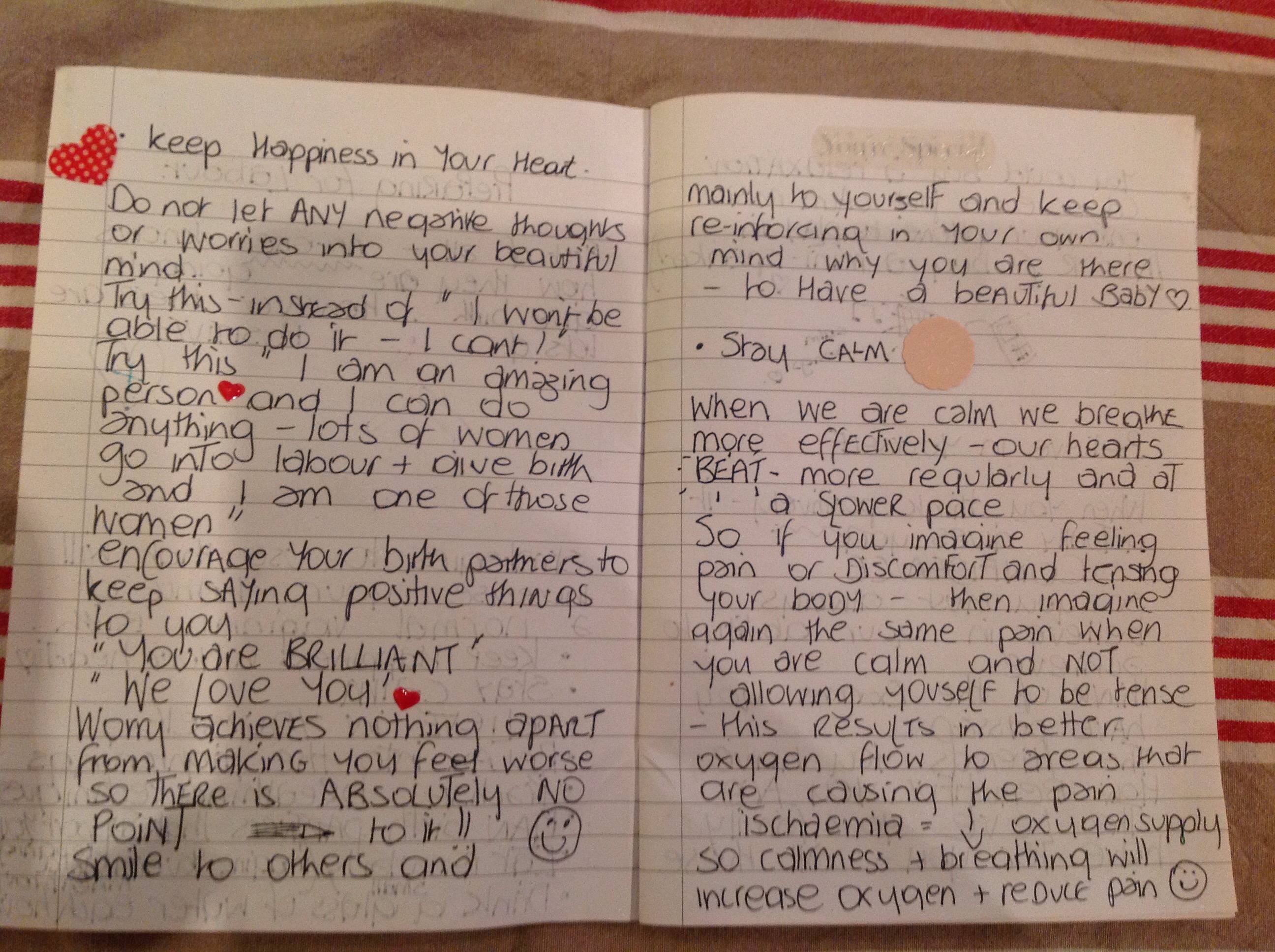
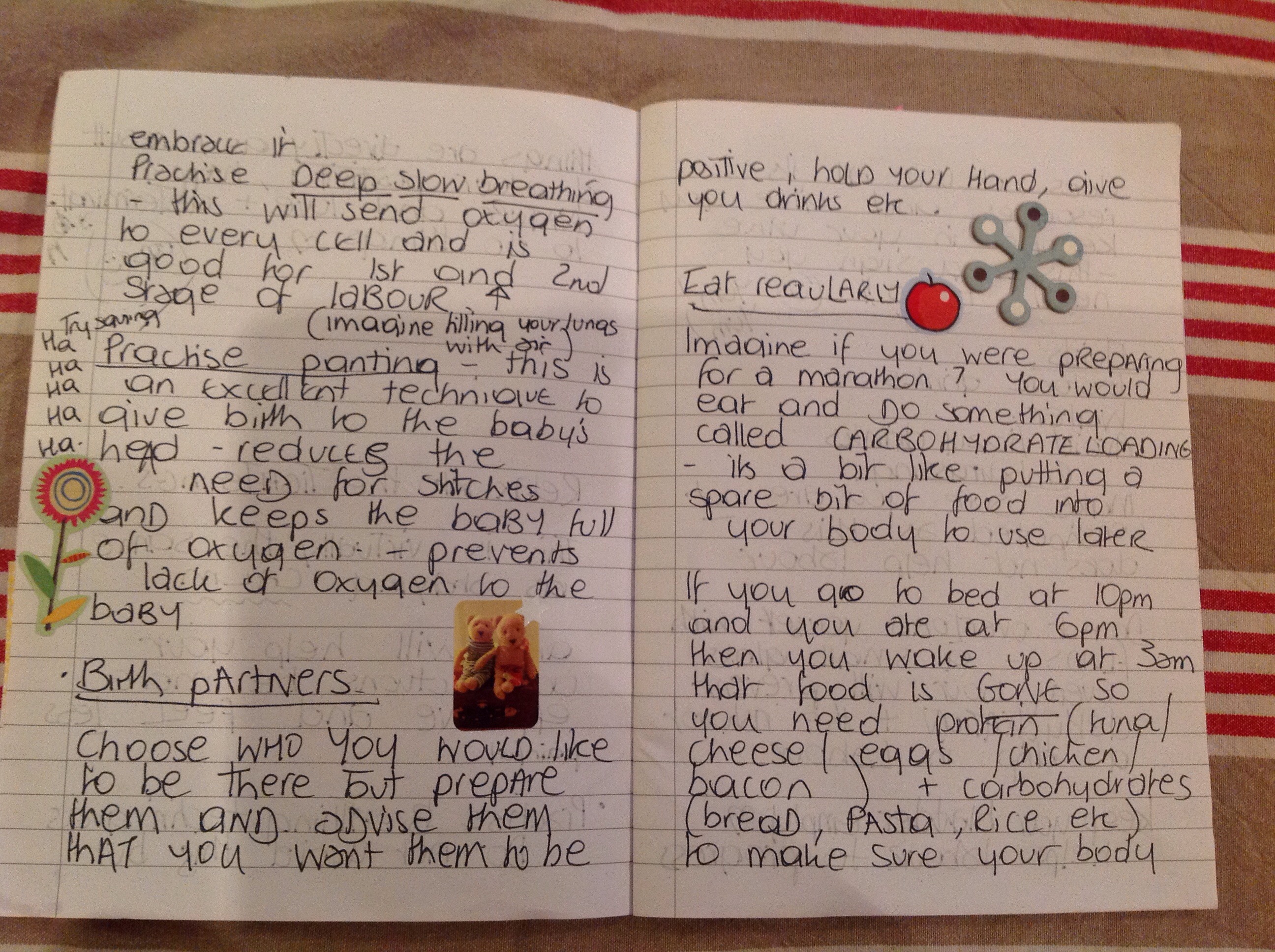
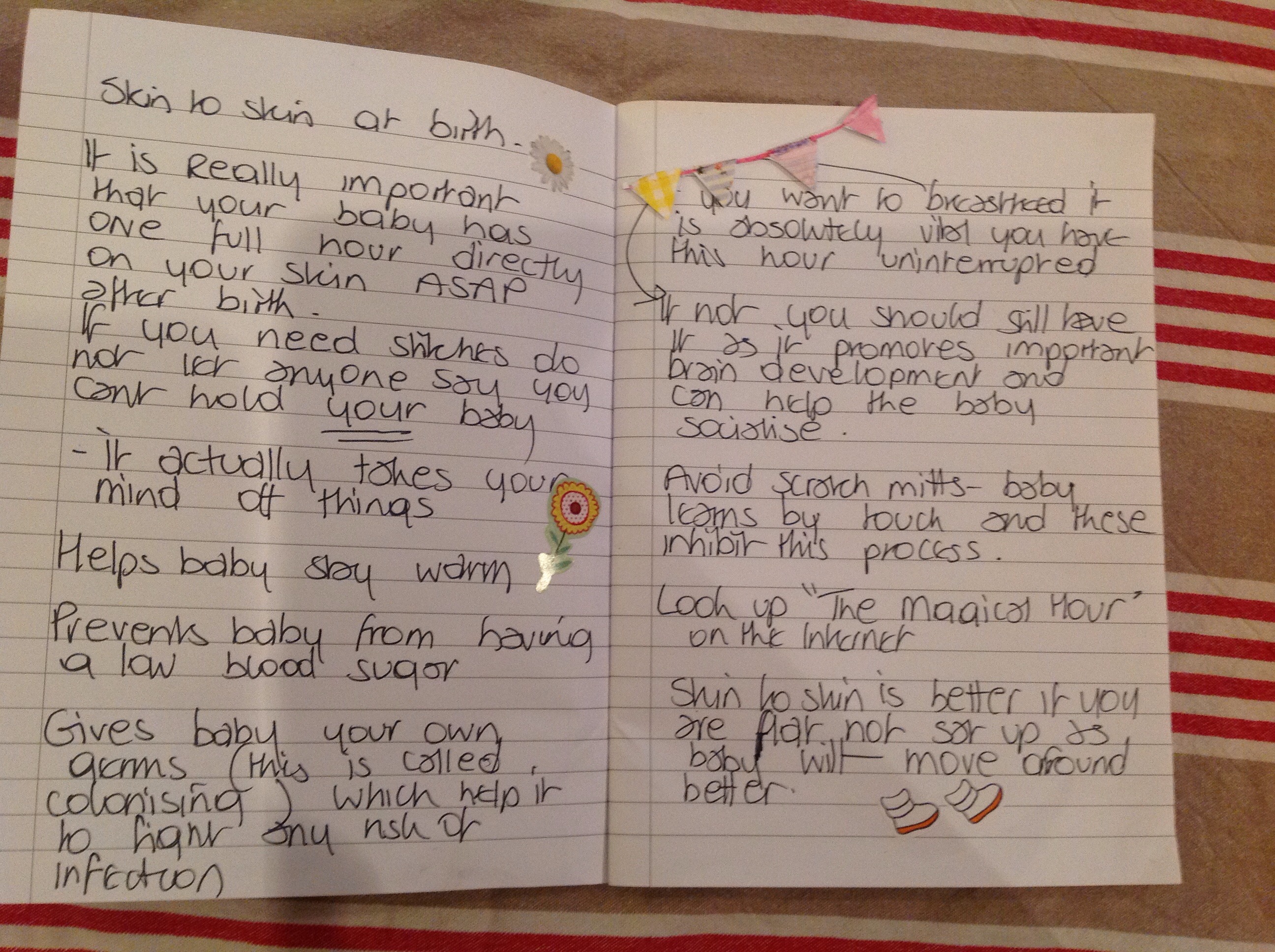
The months went by and her daughter “Verity” (name changed for reasons of privacy)  was blooming , looking beautiful everything was going well . I sensed however that she was worried about labour and I decided to make her my “Little book for labour ”  I felt I had to do something to help her prepare in order to realise her own strength and to believe in her capability to give birth . I started the book I didn’t want to make it boring or prescriptive but fun and positive . I also realised the importance of going through the book , discussing induction of labour , vaginal examinations , acting on complications, early labour, food, and breastfeeding but most of all key support people and after the birth . 

So to sum up the book was a success with Verity . We held  a  “mini” Jen & Verity one to one antenatal group in my lounge which taught me things about not just what younger women want to know (perhaps women of all ages?) . I really don’t know if I could’ve written it in the same manner if I hadn’t made it especially for Verity . She calls me “Auntie Jen” so I wrote it not just as a midwife , but as her dear mum’s friend and as an “auntie”. 

Veritys baby is now over two years old and her birth was beautiful. I wasn’t there but my friend was ,they took the book in and read it . There were no complications and the birth was physiological . 

Last night I asked Verity if I could borrow the book back to look at it – I’d not seen it for over two years. Verity had kept it safe and sound – I was thrilled that she still had it . 

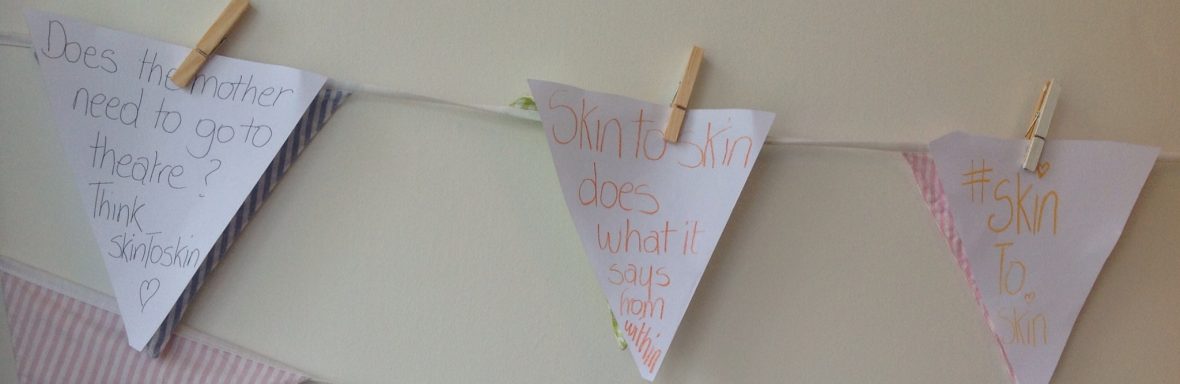
So here are a selection of pages from the book  – I am very proud of it but more proud of Verity and her beautiful daughter . It’s going straight back to Verity after I’ve published my blog.  (not her real name) 
Thank you for reading 
❤️Jenny ❤️


Babies, Birth, Courage, Kindness, Learning, Midwifery and birth, New parents, Newborn, NHS, Nursing, Patient care, Skin to skin contact, Women's rights

What Sparks Your Joy ?

I enjoy making my home feel like a warm welcoming place to my family and to friends as well as to myself  . A calm happy home gives me the ability to relax as well as work hard. However, I do own some clutter and although my home is clean I have spots that need organising . So this week I bought the book “Spark Joy” by Marie Kondo- it is about keeping items in our homes that make us feel joyous and getting rid of things that do not . Whilst reading it I was suddenly struck to consider what “sparks my joy” in midwifery? What should I cherish love and hold onto ? 

I would keep public speaking/social media , being an advocate for women , MatExp and being a mentor. I would also extol the virtues of being a “radical” Here’s why 

Public speaking and Social Media 

I really didn’t realise this until I spoke at Uclan to the future midwives and then at the Breatfeeding Festival in Manchester. Truthful feedback is imperative to me as it enables me to develop and see myself through others eyes. My focuses as a speaker are to impart knowledge , learn myself , inspire others to leave feeling they can make a difference and change the way they seen themselves perhaps to consider presenting themselves . I have to feel a positive sense of connection with the audience and I make a solid effort to achieve this as  it’s definitely important to me that presenting is a two way process . I ask questions and I learn from the audience . As well as talking about my passion for midwifery I also openly admit that I can’t know everything . I like to involve humor and also poetry – I feel so happy when others laugh and learn with me . The other reason I love attending conferences is that I network with other midwives and people who have a shared goal in making the NHS and especially maternity services even better . I see one of my key roles as tweeting at a conference to share the experience and agenda with the global midwifery network . I have made many real friends through twitter and I will continue to reiterate Eric Qualmans words “We don’t have a choice on whether we DO social media , the question is how well we DO it” I am privileged to have just written a section in an article with Teresa Chinn MBE about this topic . Teresa’s website HERE and she is the founder of We Communities which has changed the digital face of nursing midwifery medical and allied health professionals on line . Click HERE to find out more . I never in a million years realised that Twitter would connect me with such a community of compassionate and driven people . Social media is a vehicle that helps us to share information, learn and enable . This immeasurable crucial part of the infrastructure of global healthcare gave me the courage to become a blogging midwife and connect with the MatExp team but even more reinvigorated my passion to learn even more about midwifery the NHS , leadership , kindness  and start to cherish my own long hidden rebelliousness . Through THE SCHOOL FOR HEALTH AND CARE RADICALS I e found it’s ok to be radical and that change takes time and committment – if you want to learn more join the next cohort which starry this February – you will not look back (click HERE ) 

Being a mentor 

My other joy is being a mentor I love to ask future midwives how I can facilitate their learning and yet learn from them . I see myself as a radical mentor I talk about, teach and observe for compassionate care , courage and good communication. When working with students of any discipline  I feel it’s so important to hear their voice and also to be honest to them about obstacles they may encounter to prepare them for their future roles . I am a truthful mentor and it’s just so crucial that the first meeting is positive. My goal is to melt their fear or apprehension as soon as we meet  – to let them know that I am a teacher, a learner  and also that I am helping them on a journey . I do like to give spontaneous teaching sessions and find it hard to contain my excitement when future midwives tell me about  new research or publication. Mentoring also includes being a role model to peers , newly qualified midwives and reaching out to give others  help, inspiration and guidance face to face as well as through social media. I have several key mentors in my life and career who assist me through coaching and reflection which in turn aids my development as a mentor .  I love to hear news from colleagues and students as well as sharing with them new things I’ve read via social media , recommend blogs or books  to read and upcoming conferences . 

An advocate for women 

I will have been a midwife for 23 years this June. I see myself as constantly evolving and realise that I will never reach my destination – I don’t want to though I want to keep growing each day . By having this approach I  hope that I am open to women’s families and colleagues voices .I extol the long term and short term virtues and benefits of skin to skin contact at any opportunity .  Being a midwife means being a strong communicator and embracing oneself as an ambassador for global women . It’s about being current and modern despite age or experience – this ethos should apply to all who work in the NHS . Choice and consent should be embedded into our role as advocates . Cotinuity of carer must be a priority plus a positive communicative relationship  between the midwives  and  women all embedded into what we do just as much as a building needs a roof , windows , a door and warmth .  

MatExp 

Mat Exp is all about maternity experience . It’s a change platform where anyone can participate , discuss and suggest new ways to assess , plan, implement and receive care – putting the family first in Maternity services . MatExp is also about staff who are involved in this specialty and how we can improve their experiences too. This is why I adore it – everyone has an equal and valid voice – there is no hierarchy and ideas are constantly flowing . MatExp HQ exists in a virtual digital sense – it’s everywhere and a testament to the true power of social media . Due to MatExp I’ve learnt more about PostTraumatic Stress Disorder due to birth trauma which can affect men as well as women . I understand  more about the feelings of families when their babies have been stillborn or died after birth . I have been able to connect with women, families, health professionals and radicals to  spread the word about why collaboration works because we are actually doing it  . I have also met the most amazing people from all walks of life and feel I have connected with them in making a difference . Just search #MatExp on twitter or take a look at the website HERE to read about who is already involved and how you can get involved . 

So now you know what sparks joy in me- I’d like you to visualise Change as a form of  decluttering – it’s not necessarily forgetting about the old – but it’s making sure it’s archived so that we can look back as well as forwards and see why it’s so important to keep moving shifting and changing. Let’s make NHS care “Spark Joy” in the people that use it and the ones who work in it .

As a form of reflection think of four things that Spark Joy for you within your own work and life and write about them . 

Thank you for reading 

Jenny ❤️ 

Ps To my grown up children , my family and friends you also spark joy within me and you are and always will be in my heart – thank you ❤️

Babies, Birth, Breastfeeding, Discharge from hospital, Kindness, Learning, Midwifery and birth, New parents, NHS, Postnatal care, Skin to skin contact, Teaching, Women's rights

Transfer from hospital to Community care – planning in maternity services 

There is so much written about discharge planning for Care of the Elderly / Unscheduled care / patients requiring rehabilitation .

Currently there are extra pressures on maternity services and I have set out my objectives as to why I want to discuss postnatal discharge planning below 

1.To highlight beacons of positivity 

2.To inspire discussion 

3. To make discharge planning an intrinsic part of the admission process 

4. To identity where a same day transfer should not be promoted

5. To make the actual ‘time of discharge’ a governance issue  

6. Share good practice and eliminate bad practice 

7. Raise the profile of effective discharge planning in maternity services 

I have learnt from others and by listening to families how the NHS could streamline the discharge process I’m certain that this would make a positive impact on staff time , families understanding , effective communication , reduce complaints and develop a well rounded understanding of the  discharge process. 

Going home with a newborn is seen as an easy and smooth process so my blog will try to help parents as well as midwives and maternity workers to see that this is not always the case. 

The best time to be discharged home is in the morning , however the pressure on postnatal wards is immense and they have one of the fastest turnovers in the NHS . So often we hear of women and newborn being sent home at ridiculous hours and  HERE is an article about this in Mother and Baby 

So how can we streamline the discharge process ? 

A. Find out if the family have transport home 

B. Start the discharge paperwork by checking address and phone number are correct 

C. Ensure medication to take home is requested as soon as possible 

D. Promote and explain why prolonged skin to skin contact will ensure not only breastfeeding success but also maternal and newborn wellbeing and that continued skin to skin contact is important as well as talking to the newborn and feeling calm (it’s crucial to discuss co-sleeping and I usually direct parents to ISISSLEEP as well as explaining – I’m not going to go into depth about this now, but  I do with parents.  

E. Ask about support at home – visitors who come and help are very valuable and aid recovery and coping . At the same time it’s important that the new family have some time alone in order to gain confidence in being new parents and learning to recognise various cues that their newborn makes .  

F. Go through thoroughly signs and symptoms of illness for mother and baby and mention sepsis – any infection caught early improves the outcome. 

G. Ensure all levels of midwifery staff are competent to discharge women and babies home – in busy times when there are pressures on the service this will facilitate an “all hands on deck” situation 

H. Employ a discharge facilitator who can assist clinical staff to organise the paper trail 

I. Have a generic checklist to refer to primarily so that women and families can see what the process entails and secondly so that staff do not miss any of the steps involved and this will avoid mistakes and maintain communication at all levels .  

J. The first point of contact in regard to any queries should always be the labour ward and / or community midwife . Midwives are responsible for postnatal care up to 6 weeks post birth – I am proud to say that when women present at labour wards they are seen quickly – a walk in centre or a triage service are not equipped to deal with postnatal care – midwives are . 

Explanation, discussion , allowing time and two way communication are all integral to a successful discharge process . I like to tell families that the discharge is in effect a transfer of care to the community midwifery team and also what to expect from the visit. Midwives do not expect families to be up , dressed and ready with the house perfect – they are visiting to see how families  are feeling and coping . To assess if the baby is feeding well and to give support . 

Rushing the process because of pressure has no value and affects communication in a negative manner – it’s so valuable to discuss why discharging takes time at antenatal group and have information on discharge at clinic appointments . 

Ideas such as group work on the postnatal ward to increase questions and save time are being developed in various NHS trusts and discharge guidelines should be updated regularly to match the process. 

Talking about safe regular analgesia and how to take medication will improve recovery , reduce infection , help mobility and be key to reducing venous thromboembolism . Perineal pain is real – it hurts – but in the first day it may not be as bad until the woman arrives home and starts to question her pain threshold . Pain management is part of postnatal care and can make the difference between good recovery and feeling awful for days . 

Perinatal mental health care is gradually improving and it takes skill and experience for midwives to recognise it if the woman is reluctant to disclose . Continuity of carer and knowing ones midwife makes talking about postnatal depression and anxiety easier – but we still have a lot of work to do . HERE The Guardian highlights perinatal anxiety . Post Traumatic Stress Disorder is now a recognised illness caused by trauma around birth – communication and compassion at birth can reduce this and I recently received a letter from a woman telling me that skin to skin contact helped her to cope during an emergency situation – so there’s something to consider .  I am proud to know Emma Sasaru who has PTSD and courageously BLOGS  in order to help other mothers to recognise the signs and how to seek help . 

As the midwife completing the discharge YOUR responsibility is also to ensure the baby is feeding  and that you have observed a feed and given the mother support. Talking about maintaining milk supply and support groups as well as how to recognise that the baby is thriving must be discussed . It’s just as important to explain and know the family understands how to make up milk if the baby is not being breastfed.

 The neonatal examination is not a future prediction of health it just says the baby is fine at the moment it is done . Any signs like continuing sleepiness, a very quiet baby , poor muscle tone and slow weight gain might be indicators  of poor health – mothers usually have an instinct about these things so listen well and get the baby seen by a paediatrician – don’t manage the baby at home without senior input . 

Finally time of discharge is an issue – do families reall want to go home at 23.00 or 3am ? It’s a personal choice but CHOICE it must remain there is no place for sending women and newborns home in the middle of the night – does it happen in any other department? I have never heard of children being sent home in the night or elderly patients so why should we accept it for women or maternity services?  If you have concerns that families are bring sent home at inappropriate times there is action you can take – escalate it to your line manager , fill out an incident form , discuss at your team meeting and raise with your governance lead. Ask other units what they do and be pro-active . 

The main point I want to get across is that discharge from hospital is a complex process . It is much more effective when there is two way communication between midwives / obstetricians and families . Talking about going home must start as soon as the admission process starts. Discharging someone home must be a high quality , thorough , kind and efficient task. It must also be individualised and embody compassionate care . Use your skills in effective discharge and teach them to future midwives – it’s important to share good practice. 

I hope I have raised your interest  in discharge planning . I appreciate and value all feedback and understand there may be some points I have missed . My main aim is to promote thought , discussion and change . 

❤️Thankyou for reading  

Love Jenny ❤️